Posted in: by Robert C. Cumbow, Contributors, Essays, Film Reviews

emigrants & immigrants

[Originally published in Movietone News 35, September 1974]

Quite early in Jan Troell’s The New Land one realizes one is watching not a sequel, not the conclusion of a two-part magnum opus, but a second film. While The New Land represents a narrative extension of the events of The Emigrants, it also embodies a thematic and stylistic counterattack on the first film.

From the first shot of The Emigrants—the camera’s long, slow crawl over the rocky landscape of a 19th-century Swedish farm—we are aware we are watching something special; and with Troell’s hand in control of screenplay, camera, direction, and editing, we have reason to expect a one-man show, a rare level of unity and integrity in form, style, and content. In the first half-hour of the film, Troell introduces his principal characters to us through a carefully edited series of moments in their lives, selected from the passage of some five years’ narrative time. He edits not only to depict the passage of time, but also to systematically separate and dissociate his characters from their milieu: both story and style place the characters at war with their social, historical, and environmental circumstances. Karl Oskar Nilsson (Max von Sydow) is frustrated by his family’s inability to improve their lot, and by his own vulnerability to the whims of nature and a God he cannot accept. His wife, Kristina (Liv Ullmann), has a firmer faith, but is troubled by doubts and plagued with guilt because her physical love for her husband keeps saddling them with new children she fears they cannot feed. Karl Oskar’s brother Robert (Eddie Axberg) is a fledgling intellectual, disinclined to the manual labor to which he was born. Robert’s friend Arvid (Pierre Lindstedt) is the opposite, a true man of the earth, but one who is excluded from human companionship because of his simpleminded innocence. Daniel (Atlan Edwall) is a religious visionary whose ideas earn him the scorn of the Christian establishment and a price on his head. His principal follower, a former prostitute named Ulrika (Monica Zetterlund), is a social outcast with no regrets, whose efforts to find her own meaning are thwarted at every turn by social and religious persecution.

Read More “emigrants & immigrants”

Posted in: by Robert C. Cumbow, Contributors, Film Reviews, Horror

Summer of ’90: The Exorcist III

“Georgetown 1990”: A college rowing team trains on the Potomac. Suited-up runners pass by. A tired movie way of introducing life at a big-city university. It’s been done a hundred times to code Harvard. But stay with it. Just a few minutes in, our skepticism about the racing shell turns sour in our mouths as we hear the details of a brutal serial killing, its victim a young boy, crucified on a pair of rowing oars. And that’s not the worst of it.

It’s 20 years after the events of The Exorcist, and, as it turns out, after the grim reign of a monster dubbed the Gemini Killer. Following the college athletics and campus atmospherics of the opening shots, we’re introduced—at first visually only—to Jesuit teacher Joe Dyer (Ed Flanders) and Detective Lieutenant Bill Kinderman (George C. Scott), linked for us both to 1970 and to each other in a photograph we see on Kinderman’s desk.

A church is invaded by a howling wind. Statuary eyes open wide. Something very ancient and evil has returned.

Continue reading at The House Next Door

Posted in: by Robert C. Cumbow, Contributors, Film Reviews, Horror

A Passion from Hammer: ‘Dracula Has Risen From his Grave’

[Originally published in Movietone News 37, November 1974]

The tiny German village lies quiet in the early morning sunlight as a young boy enters the church, genuflects, crosses himself, and walks to the bell rope. With appropriate reverence, yet with the casualness of one who has performed this ritual many times before, he gives the rope a pull. Only this time, nothing happens. Confused, the boy braces himself for a mightier tug on the rope; but suddenly he yanks his hands away as if they have been burned. On the back of his hand is a drop of blood, and as his eyes move upward, he sees a scarlet band trickling down the bell rope. With a silent scream, he runs to fetch the village priest (Ewan Hooper). Though he is a mute, the boy expresses his agitation as best he can, and the priest follows him hurriedly to the church. Ascending the stairs to the belfry, the priest approaches the bell and pushes on it. Out swings, head-first and suspended from the clapper, the freshly killed body of a young woman.

Thus begins the most uncompromisingly religious vampire film I have seen, Dracula Has Risen from the Grave. Despite the fact that Terence Fisher gets all the publicity, and many assignations of auteurship, this lively film by second-stringer Freddie Francis gets my vote as the best of the Hammer Dracula films (though two more recent vampire ventures, Taste the Blood of Dracula, 1970, and Scars of Dracula, 1972, have received limited distribution in the United States and have thus far escaped my viewing).

Read More “A Passion from Hammer: ‘Dracula Has Risen From his Grave’”

Posted in: by Robert C. Cumbow, Contributors, Film Reviews

Review: The Towering Inferno

The Towering Inferno is a good movie about a fire. That is its strength. Its weakness is that, despite a promising array of characters and several passable actors, it is a very bad movie about people. Time was when virtually all disaster movies were essentially character studies, and examined (with varying degrees of success) how extreme circumstances bring out the best and the worst in human beings. The concerns of films as diverse as W.S. Van Dyke’s San Francisco (1936) and William Wellman’s The High and the Mighty (1954) were essentially the same: how will the characters behave under stress? Will the ordeal change them dramatically, or simply reaffirm already existing strengths and weaknesses? Even the big revival of the disaster epic, George Seaton’s Airport (1970), attempted a modest amount of character study, most notably in its treatment of the Guereros (Van Heflin and Maureen Stapleton). But already types had begun to replace characters.

Read More “Review: The Towering Inferno”

Posted in: by Robert C. Cumbow, Contributors, Film Reviews

Review: Gold

[Originally published in Movietone News 39, February 1975]

Gold is a big potboiler of a movie, filled with action, violence, gore, and adultery. It’s a genre piece, fraught with convention and predictability. It has no characters, only cartoon people whose actions are as unsurprising as their motivations are unlikely. And I enjoyed the hell out of it. The credit is due largely to Peter Hunt who, on the basis of only two films, may already lay claim to being one of the finest action directors around. Hunt had his apprenticeship as editor of several of the James Bond movies, and he has brought a skilled action-editor’s grasp of pace to the director’s chair. During the whole of Gold he gave me one minute out of 115 to sit back, temporarily bored, and say to myself, “This really isn’t very good.” And I’m not one to argue with 99.13 percent success.

Read More “Review: Gold”

Posted in: Alfred Hitchcock, by Robert C. Cumbow, Contributors, Directors, Essays, Orson Welles

Orson Welles Has a Daughter Named Rebecca

[Originally published in Movietone News 38, January 1975]

What do Hitchcock’s Rebecca (1940) and Welles’s Citizen Kane (1941) have in common? Quite a lot, it seems to me. And yet, in all my reading on film, I have run across only one brief speculation on the subject: Andrew Sarris’s, in the context of his rebuttals to Pauline Kael’s Kane articles.

Both films, to begin with, deal with the search for a hidden secret in the life of an important man, and both use a flashback framework as means of narration (though Rebecca maintains a single point of view through most of its story, while Citizen Kane crisscrosses the memories of several characters in a network of flashbacks). Both films are informed by the presence of a dead person, though Charles Foster Kane is the central character in Welles’s film, while Hitchcock’s title character never appears. Nevertheless, each film’s ghostly presence is signaled by the recurrent motif of an initial-monogram, ‘R’ and ‘K,’ respectively. In each film a scandal—hushed up in Rebecca, headlined in Kane—attends the end of the important man’s first marriage, and overshadows his second marriage to a “common” woman.

Read More “Orson Welles Has a Daughter Named Rebecca”

Posted in: by Kathleen Murphy, by Peter Hogue, by Richard T. Jameson, by Richard Thompson, by Rick Hermann, by Robert C. Cumbow, Contributors

Love Among the Ruins: 1975 in Review

[Originally published in Movietone News 47, January 1976]

“We might pass this way again”—the line from the song recurs throughout Stations, Roger Hagan’s exquisite documentary that stood out at this year’s Motion Picture Seminar of the Northwest and later graced a Seattle Film Society showing of Antonioni’s Cronaca di un amore. I seem to be passing this way again whenever a yearly assessment of the Seattle film experience falls due in January. 1975, like other recent years we’ve lived and watched through, didn’t feel in the present the way a lot of years look in the past, like a (to compound as many metaphors as possible in this silly season) cornucopia of good movies clamoring to light our way to eternity. Which is not to say that getting up a Ten Best List has been especially difficult for me, or that 1975 has failed to generate many more movies than ten that I want to pay my addresses to.

The little films, for instance, those small-scale endeavors that make no pretensions for themselves and seem ready in advance to kid any pretensions we might make for them; not award-winners or even likely nominees, not Ten Best types as long as “Best” implies more than a conviction that one will fondly remember them. But film years, and film consciousness, don’t get fleshed out without the likes of Rafferty and the Gold-Dust Twins (Dick Richards, Alan Arkin, Sally Kellerman, Mackenzie Phillips), Rancho Deluxe (Tom McGuane, Frank Perry, William A. Fraker, Jeff Bridges, Sam Waterston, Slim Pickens, Elizabeth Ashley, Clifton James, Harry Dean Stanton, Richard Bright), W.W. and the Dixie Dancekings (Burt Reynolds, Art Carney, Thomas Rickman, John G. Avildsen), and A Boy and His Dog (L.Q. Jones, Harlan Ellison, Don Johnson, Tim McIntire, Blood). In some private last analysis I prize such movies above the more generally noticeable and certainly commendable likes of Jaws, The Return of the Pink Panther, and Farewell My Lovely because it requires no last analysis to make me uneasy about, respectively, empty manipulation, however proficient, or betting a sure thing, however accomplished that sure thing may be, or gilding a generic lily even when the gilding is as affectionate and surprisingly unpretentious as Richards’ (director of Farewell as well as Rafferty).

Read More “Love Among the Ruins: 1975 in Review”

Posted in: Alfred Hitchcock, Books, by Robert C. Cumbow, Contributors, Directors

In Black & White: gawlDurgnat

[Originally published in Movietone News 44, September 1975]

THE STRANGE CASE OF ALFRED HITCHCOCK, or The Plain Man’s Hitchcock. By Raymond Durgnat. MIT Press. 429 pages. $15.00.

For me, Raymond Durgnat has become, over a period of years, The Man You Love to Disagree With. Not that he doesn’t often strike exactly home, or express wonderfully well what oft was thought. It’s just that he nearly always qualifies or obfuscates his arguments into obscurity or outrageous contrivance. The margins of his newest book, The Strange Case of Alfred Hitchcock, invite—in fact, insist on—the scribbled objections of inveterate Hitchcockians of almost any camp.

Subtitled The Plain Man’s Hitchcock, the book is both exhilarating and exasperating: exhilarating because it is the most complete and ambitious critical examination yet of Hitchcock’s entire body of work, and bids fair to become a definitive source for future Hitchcock criticism; exasperating because in more than 400 pages it never manages to become what it could have been. For one thing, it is hardly a “Plain Man’s Hitchcock,” since the facts on Hitchcock’s life and work, together with a good but simplistic summary of all previous Hitchcock commentary, are confined to two prefatory chapters; the specific analysis of the films, which comprise nearly 350 pages of the text, are neither comprehensive nor—even in the attempt—definitive.

Read More “In Black & White: gawlDurgnat”

Posted in: by Robert C. Cumbow, Contributors, Film Reviews

Out of the Past: Get to Know Your Rabbit

[Originally published in Movietone News 41, May 1975]
Get to Know Your Rabbit represents a transition in the work of Brian De Palma, from the unrestrained precocity of his grainy independents Greetings (1969) and Hi, Mom! (1970) to the more controlled and purposeful talent critics have seen in his recent films Sisters (1973) and Phantom of the Paradise (1974). Genre-parody is clearly one of the beacons of De Palma’s career so far; and what Get to Know Your Rabbit boils down to is a parody of dropping-out films. De Palma’s drop-out here, Donald Beeman (Tommy Smothers, characteristically naïve in a role that really calls for the more complex subtlety Robert De Niro brought to the earlier two films), drops all the way: from promising junior executive with an expensive apartment and a sexy mistress, to lonely flophouse roomer seeking a new lifestyle by attending a sleazy school for tap-dancing magicians. Informing the film’s plot are the untiring efforts of Beeman’s former supervisor Turnbull (superbly played by John Astin) to, first, get Donald to come back to work, and, when that fails, to build around Donald (and without his knowledge) a multimillion-dollar corporation devoted to training executive drop-outs to be tap-dancing magicians and managing their road tours through fifth-string night spots in bush-league towns.

Read More “Out of the Past: Get to Know Your Rabbit”

Posted in: Alfred Hitchcock, by Robert C. Cumbow, Contributors, Directors, Essays, Film Reviews, Horror

Caliban in Bodega Bay

[Originally published in Movietone News 41, May 1975]

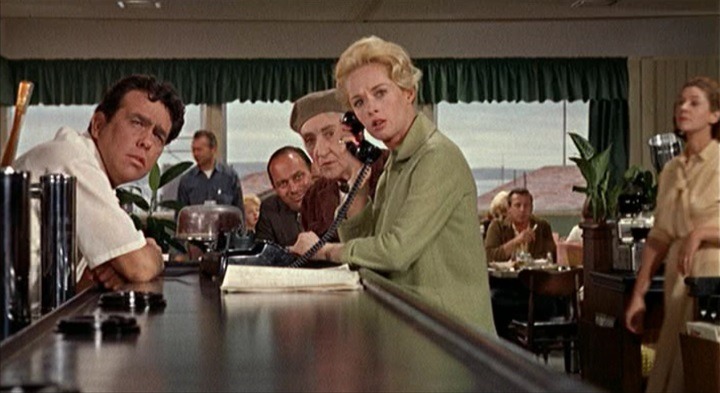
The birds have really made a mess of Bodega Bay. Smoke from a gasoline fire hangs heavy over the city; bodies lie in the streets: abandoned automobiles, smashed windows, and ripped woodwork are grim evidence that the human beings have not won this battle. With Mitch Brenner’s help, Melanie Daniels has escaped the glass cage of a telephone booth and made her way to the relative safety of the town’s central meeting place, a small café.

At first, the place appears empty; but, exploring further, Mitch and Melanie discover, cringing in a back hallway, a frightened group of townspeople and visitors. As Mitch leads Melanie into this refuge, a woman comes forward. We have met her earlier: a distressed mother whose concern for the safety of her two children has prompted her to demand that the café’s patrons not discuss the inexplicable violence of the birds within the range of juvenile ears. Her escape from Bodega Bay has been thwarted by the birds’ massive assault on the town, and the violent death of the traveling salesman who was to guide her to the freeway.

Gazing at Melanie with only slightly controlled hysteria, the woman says, with mounting shrillness: “They said when you got here the whole thing started. Who are you? What are you? Where did you come from? I think you’re the cause of all this. I think you’re evil! Evil!” Robin Wood points out that these words, spoken as they are to the subjective camera, can constitute an indictment of the audience, whose bloodthirst encourages the brutality of the birds’ attacks. But of course the woman’s outburst is met with a firm defensive slap in the face, also delivered by the subjective camera, and the opposition, though not defeated, is neutralized.

‘The Birds’ – In the diner

Hitchcock and scenarist Evan Hunter may have included this little encounter in anticipation of the likelihood that many critics and viewers would embrace that simplistic suggestion, that Melanie, witch-like, had brought a curse with her to Bodega Bay. That specific notion is dispelled by radio announcements of bird attacks in other areas, and more finally by Melanie’s own victimization by the birds. But the overtone of witchcraft is not to be discarded entirely. We have already learned that the birds’ uprising coincides with the coming of the full moon, a revelation that evokes the darker traditions of folk myth.

And—all other considerations aside—the woman’s hysterical accusation is founded in fact: the bird attacks did start with Melanie’s arrival in the town, and this inevitably gives us a sense of the birds’ significance, even though the inculpation is misdirected.

Read More “Caliban in Bodega Bay”