Posted in: by Robert C. Cumbow, Contributors, Film Reviews, Horror

Review: Embryo

[Originally published in Movietone News 51, August 1976]

Attention to detail is of the essence in a fantasy film. If fantasy is to have the desired effect, everything hinges on the viewer’s willingness to suspend disbelief and submit to the film’s premises wherever they may take him. But if every shot, every moment, every idea offers only new evidence as to how unlikely the proceedings are, no viewer will sit patient for long. Only the very best science fiction films escape the need to explain and justify themselves. But Ralph Nelson’s Embryo seeks to escape it through the back door, by disclaiming any affiliation with science fiction. An opening title assures us that this film is about the possible abuses of things which are already medical possibilities. The disclaimer might have some effect, were it not for Nelson’s inattention to detail, which repeatedly emphasizes the film’s hokiness to the total exclusion of whatever credibility the Thomas-Doohan screenplay might have had to begin with.

Read More “Review: Embryo”
Posted in: by Robert C. Cumbow, Contributors, Film Reviews

Review: Annie Hall

[Originally published in Movietone News 54, June 1977]

In Annie Hall Woody Allen has created his most personal, most serious, most painfully funny, and best film. The first three don’t necessarily imply the last, but in this case that’s the way it works out. The concern with the interrelation between comedy and pain—a transformation of the earlier Allen’s more prosaic concern with love and death—is the center of the film, as it is the center of the life of standup comic Alvy Singer, Allen’s thinly disguised portrait of himself. The simultaneous egocentricity and self-denigration implied in Allen’s portrayal of Singer—and, indeed, in Allen himself—is summed up in his delivery of a classic joke in his opening, Bergmanesque monologue. Like most of the jokes Freud cites in his Jokes and Their Relation to the Unconscious, it’s not the kind of joke you laugh at: “I wouldn’t want to join a club that would have me for one of its members.” True, Allen’s throwaway style evokes a chuckle; but for Alvy Singer there is more painful truth in this paradox of a joke than there is comic hilarity. It’s actually the second of two jokes that open the film, the first being an even less laughable one about life being ugly, miserable, depressing, and all too short.

The proposition that life is both agonizing and dear is sustained throughout. When record entrepreneur Tony Lacy invites Alvy Singer to a party that promises to be “very mellow,” Alvy declines, explaining, “When I get too mellow I ripen, and then I rot.” The vision of life-vs.-death pervades everything (“All the books you ever gave me had Death in the title,” girlfriend Annie Hall complains), and the double-layered vision is reflected emphatically in the film’s imagery. Alvy was born and raised in a house underneath the rollercoaster at Coney Island: superficial joy on top of nervous depression: corrosive death gnawing at the underpinnings of assertive life. Alvy’s comedy—and the play he writes about himself and Annie near the end of the film—is his response to pain, and it is a fantasy response. The play ends the way Alvy wishes the real relationship with Annie had climaxed. Elsewhere he casually produces Marshall McLuhan from behind a theater lobby sign to refute the bullshit artist in the ticket line who pontificates about McLuhan without knowing his work. “If life could only be like this!” Alvy tells the camera, acknowledging and embracing his own dependence on a fantasy of a world that will reaffirm and justify him and his ideas. In the film, people on the street don’t mind being stopped by Alvy to give their point of view, or elucidate their corner of the world; and many of them seem to have information and understanding to which he is not privy, though they are happy to share it with him and offer advice.

Read More “Review: Annie Hall”
Posted in: by Robert C. Cumbow, Contributors, Film Reviews

Review: Looking for Mr. Goodbar

[Originally published in Movietone News 57, February 1978]

I was going to put Looking for Mr. Goodbar on my end-of-the-year list as “Best Film of 1967.” But although Richard Brooks’ self-consciously flashy techniques are at least that dated, I think even a decade ago his shallow, cheating approach to both subject and audience would have been seen for what it is. Several times in the course of the film, Brooks segues his narrative line into a surprising but dead-end sequence that—after a shock-cut back to reality—proves to have been a fantasy of the main character, Terry Dunn. The first couple of times this happens, the audience has no basis for regarding the sequence as fantasy, since Terry is never portrayed as a woman who can’t tell the difference between reality and fantasy. Even later, the audience picks up on the cutaways to fantasy only because by now it is on to Brooks’s tricks. Never does the device have any integral bearing on the film’s theme or style.

Read More “Review: Looking for Mr. Goodbar”
Posted in: by Robert C. Cumbow, Contributors, Film Reviews

Review: Interiors

[Originally published in Movietone News 60-61, February 1979]

As if to avoid distracting mumbles of “Oh, guess where he got that!” in the middle of his unashamedly imitative first non-comedy, Woody Allen gets his most Bergmanesque shot out of the way right up front. It’s a soft, dreamy, quiet interior of a woman running her hand inquiringly across a windowpane; and it establishes straightaway the film’s inside/outside polarity, with the woman seemingly trying to comprehend the shell that separates one existence from another. The glass of the window, like the wall of the eye, or the lens of the camera, is the transparent, impenetrable, inexorable demarcation between the in-here and the out-there. Nothing new; but from here Allen goes on to build a distinctly American Bergman film, accessible, even downright obvious in contrast with the Swedish master’s arcane musings.

Read More “Review: Interiors”
Posted in: by Robert C. Cumbow, Contributors, Film Reviews

East Egg, West Egg, Rotten Egg: ‘The Great Gatsby’

[Originally published in Movietone News 31, April 1974]

A film made from a novel sets itself a double task. First, like all movies, it must strive to be good cinema; second, it must try to fulfill the expectations of those who have read the book. When the book is an acknowledged classic, the second becomes more important than the first. It is then incumbent upon the critic to deal fairly with the film on both levels, for many a film has succeeded as cinema despite (or even because of) its failure as an interpretation of literature. The Great Gatsby is, alas, not one of those films.

Not that it is necessarily disappointing or dissatisfying (although what film could be fully satisfying after such a supersaturating promotion campaign?). The way to approach The Great Gatsby is to prepare to be disappointed. If you have no illusion that the film is going to be an effective representation of the novel, then far from being disappointed, you may be pleasantly surprised. But few who love the novel will be capable of such detachment.

Read More “East Egg, West Egg, Rotten Egg: ‘The Great Gatsby’”
Posted in: by Robert C. Cumbow, Contributors, Film Reviews

Review: ‘French Connection II’

[Originally published in Movietone News 43, September 1975]

The main strength of William Friedkin’s The French Connection lay in the driving pace of its montage, which assembled the film’s fragmentary narrative into a single, compelling forward movement toward the climax and the inevitable results of Detective “Popeye” Doyle’s recklessness, revealed in the cryptic final title. John Frankenheimer has, by contrast, always leaned heaviest on frame composition to express his vision, and as a result his new film is a French Connection of quite a different cut.

Read More “Review: ‘French Connection II’”
Posted in: by Robert C. Cumbow, Contributors, David Lynch, Film Reviews

Summer of ’90: ‘Wild at Heart’

[originally published on The House Next Door on August 14, 2015]

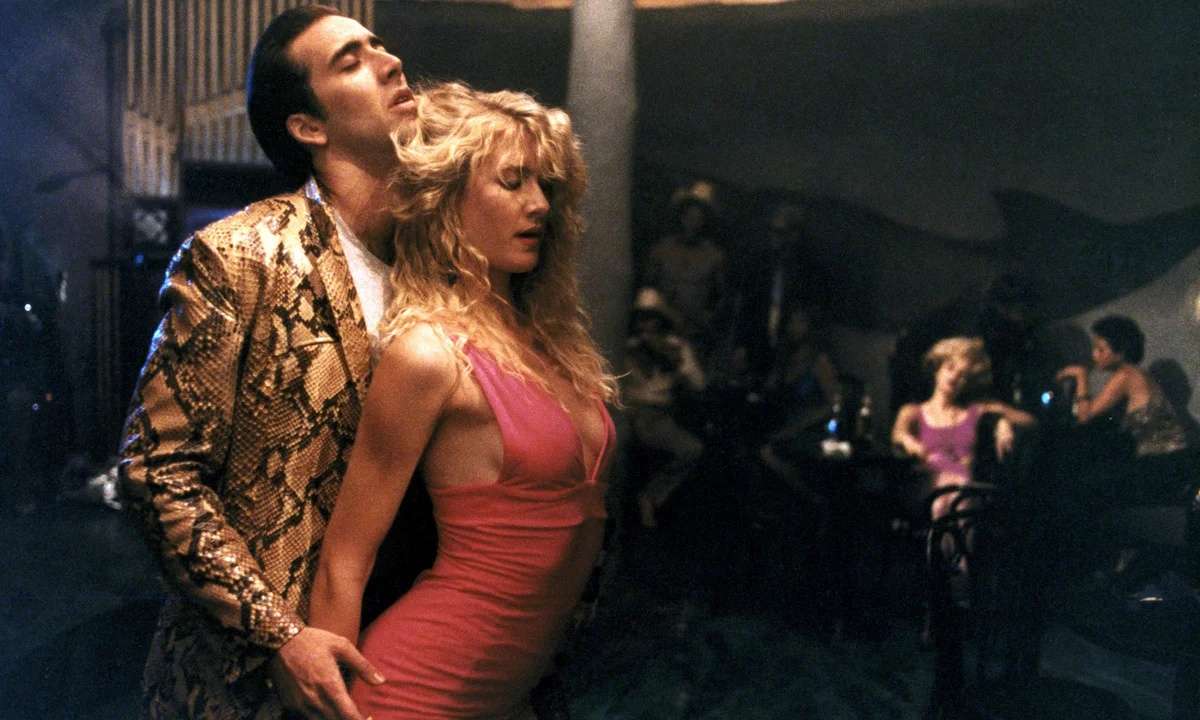
The power of David Lynch’s Wild at Heart is the endurance of an Elvis Presley song (or two), the staying power of a children’s movie, and the sight and sound of a match being struck: romantically mellow, wackily comic, and deadly, darkly serious.

Lynch gets more and scarier mileage out of fire in Wild at Heart than he did out of Frank Booth’s lighter in Blue Velvet. In between the two came the game-changing Twin Peaks, which, soon after Wild at Heart, Lynch would round off with Fire Walk with Me. It’s easy to see the whole arc from Blue Velvet to Fire Walk with Me as part of a single centralizing vision, an identifiable phase of his artistic development—his “fire period,” if you like.

You find it everywhere in the reds and yellows of Wild at Heart: fire as a murder weapon; fire as the spark of recollection and of wisdom; not only a destructive force, but a creative one as well. The reds and yellows of Wild at Heart recall the reds of Hitchcock’s Marnie—the nagging, ever-present trigger to a memory that hovers just outside the border of consciousness and refuses to be grasped and confronted in all its detail. There as here we see red washes shroud the screen like the curtain between the lies we live and the truth we can’t face. Sailor tells Lula: “We all got a secret side, baby.”

Read More “Summer of ’90: ‘Wild at Heart’”
Posted in: by Robert C. Cumbow, Contributors, David Lynch, Film Reviews

Review: Eraserhead

[Originally published in Movietone News 58-59, August 1978]

While an attendant whose deformed face and skin make him look like the Elephant Man pulls levers like those that start an amusement park ride, an ectoplasmic spermatozoon plunges squirming into a pool, making its way toward a globe that gradually crumbles, until we take the viewpoint of that globe and find ourselves sliding through a hair-rimmed aperture into a bright white beyond. Conception and birth, right? But of what?

Every time you think you’ve got hold of Eraserhead, you haven’t. A curly-haired macrocephalic strolls zombielike through a surreal landscape that is both identifiably urban and suggestively a macrophotograph of some portion of human anatomy. Lights come on but don’t light anything up; the bars of a radiator part like curtains to reveal a dancing woman on a tile stage; a manmade roast chicken no bigger than a fist squirms and bleeds when someone tries to carve it; a man and woman live with their hideous birdlike baby in a dingy flat whose floors and shelves are covered with some tangled, decaying fibrous matter—all of this against a soundtrack of incessant pounding, hissing, squeaking noises, and in the most frightfully claustrophobic black-and-white you’ve ever seen.

If you really give yourself to the film (and there’s a point beyond which it’s pretty hard not to), you pretty soon find yourself shifting a little, seeking out the reassuring glow of the exit light or suppressing the impulse to say to your neighbor “I gotta find some way outta here!” I don’t subscribe to the notion that seeing a film—or any work of art—can damage the viewer; but if anyone could demonstrably suffer permanent damage from seeing a film, there’s a good chance that the film would be Eraserhead. I saw it, and count myself among the walking wounded. The film makes all other so-called “dream” films pale by comparison: it is the most thoroughly oneiric—in fact, literally nightmarish—film I’ve ever seen: vivid, disorienting, captivating, stirring in me terrors whose names I don’t even know. From the field of the personal (or “underground”) film, where there is so much self-indulgent crap, and so much more careless fakery, Eraserhead emerges as a truly subversive film. It gets personal with the viewer in ways so intimate, so embedded in the private recesses of consciousness you wouldn’t have thought it possible. Who is this David Lynch and how does he know? This is what madness might be like, he makes you think, this oppressive absurdity, now funny, now scary, now just plain weird, but making a kind of sense that has nothing at all to do with reason. Believe it: Eraserhead is The Real Thing.

© 1978 Robert C. Cumbow

ERASERHEAD
Direction, screenplay, special effects, editing, production: David Lynch. Camera and lighting: Fred Elmes, Herbert Caldwell.
The players: John Nance, Charlotte Stewart, Allen Joseph, Jeanne Bates.

A pdf of the original issue can be found here.

Posted in: by Robert C. Cumbow, Contributors, Directors, Film Noir, Film Reviews, John Huston

Out of the Past: The Maltese Falcon

[Originally published in Movietone News 26, October 1973]

The Maltese Falcon showed up in the area recently, for the hundredth time. Hohum? Far from it! Let there be a hundred more! Huston’s first film set the standard for his later work, a standard of excellence that has rarely been matched by his more recent films. In The Maltese Falcon Huston was already developing the pattern that would characterize his finest films: the introduction of an intrigue-suspense plot that’s soon completely subordinated to characterization. In films like The Treasure of the Sierra Madre, The African Queen and The Kremlin Letter, we become so taken with the characters, the human truths they represent, and the stylish manner in which they are portrayed, that the actual plot line becomes insignificant; and if the Maltese Falcon or the Kremlin letter should prove to have been red herrings all along, it matters not a whit.

Read More “Out of the Past: The Maltese Falcon”
Posted in: by Robert C. Cumbow, Contributors, Film Reviews

Review: The Bingo Long Traveling All-Stars and Motor Kings

Robert C. Cumbow's 1976 review from Movietone News #52: "

[Originally published in Movietone News 52, October 1976]

Like most films with a baseball setting, The Bingo Long Traveling All-stars and Motor Kings is not essentially about baseball. Not that baseball is altogether a bad thing for a movie to be about (though in these days of the once-great sport’s waning popularity a real baseball movie might well die at the box office); it’s just that baseball is so damned useful to film makers as metaphor. One of the most exciting moments in Bingo Long occurs when Charlie Snow, a player on the barnstorming independent baseball team of the title, slips out of the game momentarily to relieve himself and suddenly finds a razor at his throat. The razor belongs to the hired goons of funeral director Sallison Potts, who is trying to intimidate Bingo Long and his team of unaffiliated black players into giving up their enterprise and returning to his Negro National League franchise. A closeup shows us the razor against Snow’s chest; a short cry escapes his mouth before it’s stifled by one of the goons. It’s too quiet just now: Snow’s screams would be heard. “Wait till Leon tags one,” says the second goon; “wait till the crowd roars.” At bat is slugger Leon Carter, whose big hit we have been waiting for and are now dreading. The pitcher winds up and delivers—and it’s a ball. And it’s a breathless moment in the theater. But it’s also essentially a denial of the excitement of baseball. Those who know baseball and consider it important don’t need a man’s life riding on the next pitch in order for it to be an exciting, tense experience.

Read More “Review: The Bingo Long Traveling All-Stars and Motor Kings”