Posted in: by Sean Axmaker, Contributors, David Lynch, Interviews

Interview: David Lynch on ‘Inland Empire’ I – The Idea

[originally published on Greencine, August 2007]

David Lynch, the once boyish maverick of such dark, demanding, and confounding films as Blue Velvet and Lost Highway (not to mention the gentle, G-rated slice of slightly askew Americana, The Straight Story), is 60 now. You can see his age in has face and his graying hair (still wildly brushed as if trying to escape his head), but his output is, if anything, even greater now. He’s producing short films for his website, painting, even marketing his own signature coffee.

And he’s still making films the only way he knows how: his way. He made heady and dreamy three hour drama Inland Empire, shot totally on digital video (his first feature made in that format), with such Hollywood pros as Laura Dern and Jeremy Irons, yet financed and produced completely outside of Hollywood.

“It’s mostly common sense making films,” he insists. “You don’t need a studio. You need some money and you need ideas and then you go make your film.” He even bypassed the studio system to distribute the film independently. “There are many, many, many great theaters available to people and that’s the place where people see films,” he explains. “So if you can get your film into a theater, that’s all you need. And now you can make your own DVDs. If you have a conduit to stores, you put them down that conduit. Again, it’s a lot of common sense.”

Lynch came to Seattle in January 2007 to appear at a special preview screening of Inland Empire and talk at Town Hall on Transcendental Meditation and granted a few select interviews. Dressed in his trademark neat white shirt and simple black suit, he sat back for the interview with a cup of coffee within reach and an occasional cigarette between his fingers. Soft-spoken and pleasant, calm and confident, answering most questions with simple and succinct answers, he comes off as a gentle but eccentric elementary school teacher patiently trying to explain filmmaking and the creative process as if it were nothing more than basic addition and subtraction.

You wrote in your book, “Catching the Big Fish,” that you spent a lot of time in the woods while you were growing up. Is that where the settings and atmosphere of Blue Velvet and Twin Peaks came from?

Wood is an influence, but it wasn’t… I always pictured Blue Velvet as having lumber around it, but it was shot in North Carolina. But there’s a lot of lumber around in North Carolina, too, so it worked out. But I pictured it more as a Northwestern kind of town. Then when Twin Peaks came out, yeah, there’s things, but I wrote it with Mark Frost, he’s not from the Northwest. There’s always things about our childhood that ideas come from. So it was an influence for sure. The woods. Wood and woods.

Blue Velvet captured something I’d never seen any other movie do at that time. It presented what should be a simple and peaceful rural community and revealed this dark layer underneath the surface, not simply a criminal underworld but a moral underworld. And I had lived for a year in La Grande, Oregon, which Blue Velvet‘s Lumberton evoked perfectly for me.

There’s a dark layer underneath every community. Looking back, people made a big deal about Blue Velvet showing the surface and then something under the surface. Since then, if you see TV and newspapers, more and more has been revealed that was hiding there all along. I say the sickness is being revealed and people are dealing with it, which I guess is a good thing. So it’s not just La Grande, or it’s not just in Twin Peaks or Lumberton, it’s everywhere.

Read More “Interview: David Lynch on ‘Inland Empire’ I – The Idea”
Posted in: by Sean Axmaker, Contributors, David Lynch, DVD, Interviews

Interview: David Lynch on ‘Inland Empire’ II – The DVD

Back in 2007, in conjunction with the release of Inland Empire, I had the opportunity to interview David Lynch twice in the same year. This is the second of the two interviews, conducted over the phone and focused on the DVD release of Inland Empire, which he produced and distributed independently through his company Absurda. An edited version was published on MSN, as part of the “What’s in Your DVD Player” series. Here is a longer version of that interview. Lynch talks about movies and DVDs, what his favorite movie is and why commentary is “the worst possible thing a person can do.” – SAx

What’s the last DVD that you’ve seen?

I saw The Hustler last week, with Paul Newman, Piper Laurie, Jackie Gleason and George C. Scott. It’s a great film. It’s black and white and it really sets a place and a time and a world and I really enjoyed watching it again.

I love the photography by Eugene Shuftan, and all the great poolroom footage with the haze and the smoke.

It’s really, really a well made film. Really tight and great performances, really good writing. It’s a very interesting film.

Do you have a favorite DVD?

Sunset Boulevard. Tonight we’re going to the Billy Wilder Theater, and Billy Wilder’s Sunset Boulevard is maybe my favorite world to go into, for sure in the top ten worlds to go into.

Do you ever check out the DVD supplements?

Hardly ever. But I gotta say, on the Inland Empire DVD, they’re worth checking out.

You have of course never done a commentary track, but you do load up the Inland Empire disc with a lot of interesting extras and the “Stories” section could almost be a stand-alone commentary because you talk about so many things around the film.

I believe talking is okay separate from a thing, but a commentary track that goes along through a film, I think is maybe the worst possible thing a person could do. From then on, the film is seen in terms of the memory of that commentary and it changes things forever. Things are rounded if they’re separate. Stories surrounding a film or things surrounding it, that’s a different kind a thing and I think those things are okay.

Read More “Interview: David Lynch on ‘Inland Empire’ II – The DVD”
Posted in: by Kathleen Murphy, Contributors, David Lynch, Essays, Film Reviews

Dead Heat on a Merry-Go-Round: David Lynch’s ‘Wild at Heart’

[Originally published in Film Comment, November-December 1990]

Back in the days when James Dean was only half a decade dead and Elvis Presley as many years famous, my best friend and I twice played hookey from high school to see Sidney Lumet’s The Fugitive Kind. On screen in brooding black and white, Tennessee Williams’ surreal parable—originally Orpheus Descending—played like an overheated projection of our small-town dreams and nightmares. Poised to get on any road, college-bound in a few months, we imagined in our terrible innocence that it might be possible to beat our way clear of Our Town’s soul-killing dumbness and repression. For us, Lady Torrance (Anna Magnani, a dark and smoldering earth-mother of 52) and Valentine Xavier (the 36-year-old Marlon Brando, still beautiful) acted as something like outlaw parents, larger than life in their sexual authority. We understood that this beatnik Adam and Eve could not escape crucifixion by the community’s paternalistic thugs: Gardens, artists, blacks, holy sluts and studs—any life that moved and flourished outside the townfolk’s small ken—had to be burned down.

Anna Magnani and Marlon Brando in ‘The Fugitive Kind’

In the ashes of the film’s last conflagration, an old black “conjure man” uncovers Brando’s signature snakeskin jacket, the advertisement of his wild-child sexuality and the promise of future comebacks. It’s Carol Cutrere (Joanne Woodward), a lost soul once jailed as a “lewd vagrant,” who falls natural heir to Brando’s mantle: “Wild things leave skins behind…. They leave clean skins and teeth and white bones, and these are tokens passed from one to another so that the fugitive kind can follow their kind.” When this born-again blonde—a dirty sailor’s-cap pulled down over her unkempt hair, her eyes bleared by mascara and too much “jukin'”—slides into her mud-spattered white Jaguar and drives out of town at dawn, she’s blessed by more radiance than Lumet’s little corner of Hell has yet permitted. Her going is witnessed by a lively bird perched on an overarching branch in the foreground. No Blue Velvet bug is being scissored to death in the beak of that robin, if robin it is. For my best friend and me, lewd vagrants that we fancied ourselves to be, The Fugitive Kind was a ticket to ride, leaving our Lumberton far behind in the hope that life in a road movie might lead to Heaven.

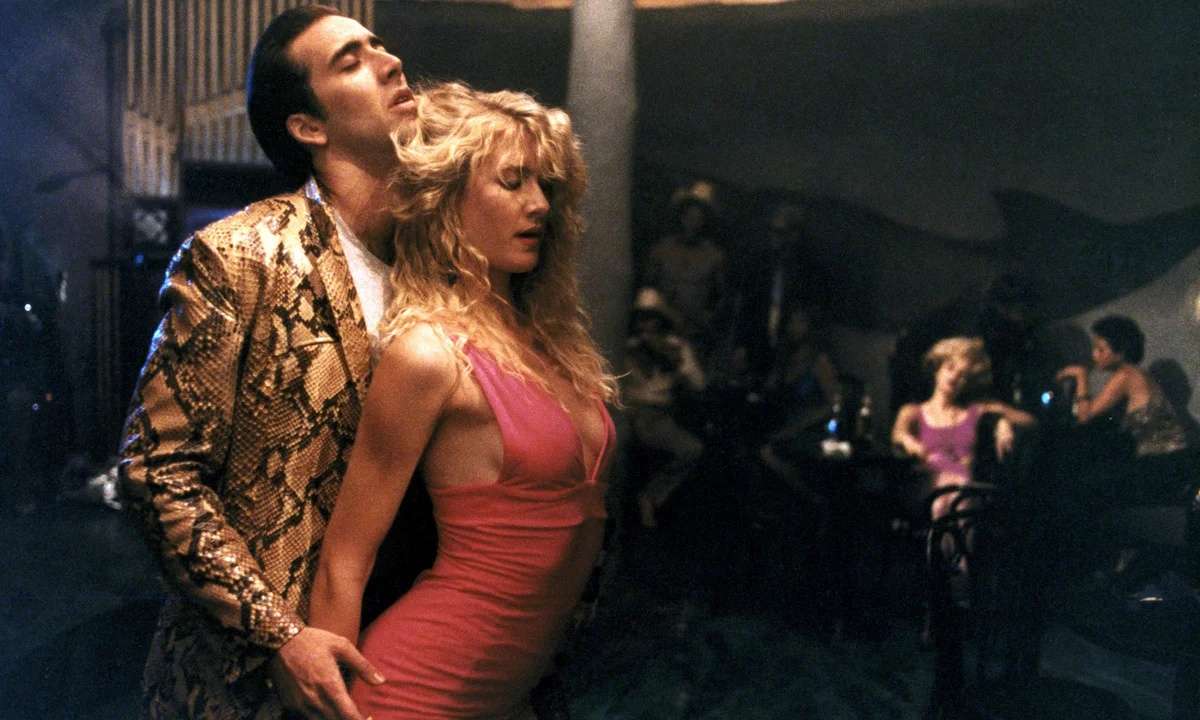
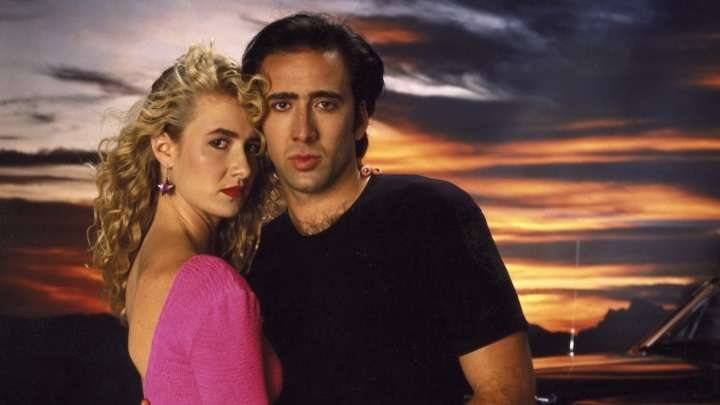
Thirty years later comes Wild at Heart, a film about two cheerfully lewd vagrants for the Nineties, Sailor Ripley and Lula Pace Fortune. And director David Lynch, for whom a road movie is just another birth canal, has deliberately swaddled his hero in that familiar snakeskin jacket.* While the deeply romantic narrative of The Fugitive Kind labored to deliver a bird from its cage, Wild at Heart’s storyline takes the form of a snake whose tail ends up in its mouth.

Read More “Dead Heat on a Merry-Go-Round: David Lynch’s ‘Wild at Heart’”
Posted in: Blu-ray, by Sean Axmaker, Contributors, David Lynch

The Unseen ‘Blue Velvet’

[Originally published in 2011]

While it’s become a kind of Hollywood exercise for directors to re-edit and extend films for home video, David Lynch has never succumbed to the temptation. The film that arrives in theaters is, for better or worse, the film that will live on.

In terms of Blue Velvet, it is definitely for better. After the frustrations of Dune, producer Dino De Laurentiis gave Lynch a free hand and creative control over Blue Velvet and Lynch released the film that he intended.

Blue Velvet debuts on Blu-ray from MGM this week with a newly remastered edition of the film, but it also features a unique peak into the creative process of Lynch with a collection of recently rediscovered deleted scenes: 50 minutes of visions, both lovely and horrible, human and hellish.

Peeking in on the hidden world of ‘Blue Velvet’

These pieces were pared away in the editing, like a sculptor chiseling away to get to the perfect form, but they are full of visual delights and offbeat humor, narrative sidetrips and character embellishments. Some scenes simply cast a mood of unease or anxiety over the proceedings. Yet all are glimpses into the inspiration and explorations of Lynch as a filmmaker and marvelous addenda to the finished film, a look into roads not taken and details whittled away to reach the narrative focus and tonal balance of the final piece.

Lynch oversaw the editing of this collection of scenes and his simple construction gives the supplement a unity. As presented on the disc, with the scenes edited into a loose narrative of their own, it’s like a companion film focusing on the life of Jeffrey Beaumont (Kyle MacLachlan) at college and at home, full of suggestions of Jeffrey’s dark side long before Dorothy Vallens (Isabella Rossellini) and Frank Booth (Dennis Hopper) enter his life. There is more with Sandy and her football quarterback boyfriend, many more scenes with Hope Lange as Jeffrey’s mother and a deleted storyline around the termite infestation investigated by Aunt Barbara (Frances Bay), dramatized with a slowly creeping camera and ominous chords, as if it’s more evidence of the rot of evil under the facade of the town.

While Lynch is never one to revise a finished film, he’s clearly proud of the work in these deleted scenes. “It was too much of a good thing,” is how he once explained cutting a favorite scene, but he’s happy to share those good things with us. He personally supervised the editing of these clips into a 50-minute supplement on the new Blu-ray. (For more on the search for the footage, see Cath Clark’s article in The Guardian.)

You can see one of the cut scenes below the jump.

Read More “The Unseen ‘Blue Velvet’”
Posted in: by Robert C. Cumbow, Contributors, David Lynch, Film Reviews

Summer of ’90: ‘Wild at Heart’

[originally published on The House Next Door on August 14, 2015]

The power of David Lynch’s Wild at Heart is the endurance of an Elvis Presley song (or two), the staying power of a children’s movie, and the sight and sound of a match being struck: romantically mellow, wackily comic, and deadly, darkly serious.

Lynch gets more and scarier mileage out of fire in Wild at Heart than he did out of Frank Booth’s lighter in Blue Velvet. In between the two came the game-changing Twin Peaks, which, soon after Wild at Heart, Lynch would round off with Fire Walk with Me. It’s easy to see the whole arc from Blue Velvet to Fire Walk with Me as part of a single centralizing vision, an identifiable phase of his artistic development—his “fire period,” if you like.

You find it everywhere in the reds and yellows of Wild at Heart: fire as a murder weapon; fire as the spark of recollection and of wisdom; not only a destructive force, but a creative one as well. The reds and yellows of Wild at Heart recall the reds of Hitchcock’s Marnie—the nagging, ever-present trigger to a memory that hovers just outside the border of consciousness and refuses to be grasped and confronted in all its detail. There as here we see red washes shroud the screen like the curtain between the lies we live and the truth we can’t face. Sailor tells Lula: “We all got a secret side, baby.”

Read More “Summer of ’90: ‘Wild at Heart’”
Posted in: David Lynch, Essays

David Lynch Folds Space: Because He Is the Kwisatz Haderach!…

[Editor’s Note: The essay below was first published on 16/11/2006 at 24LiesASecond, a now-defunct website, under the editorial guidance of James M. Moran (editor-in-chief) and Peet Gelderblom (founding editor).]

The spice extends life. The spice expands consciousness. The spice is vital to space travel. The Spacing Guild and its Navigators, whom the spice has mutated over four thousand years, use the orange spice gas, which gives them the ability to fold space; that is, to travel to any part of the known universe without moving.
—Princess Irulan, in David Lynch‘s Dune

That’s what David Lynch’s Dune does: It gets us from place to place and from beginning to end without ever seeming to move—at least in the way that a more conventional science-fiction action thriller is expected to move. The unkindest viewers and critics have called it boring.

Even the film’s action sequences sit in the memory more as tableaux than as moving images. “My movies are film-paintings,” Lynch said, in a 1984 interview during post-production on Dune. What strikes us even as we watch the film, and comes back most in our recalling of it, is the composition more than the dynamic—posture more than gesture:

  • Paul with his hand in the box, his imagination conspiring with the mental powers of the Bene Gesserit to objectify a pain that exists only in the suggestible mind
  • Paul’s mentors, Gurney Halleck, Thufir Hawat, and Wellington Yueh, introduced to us as a human triptych
  • Feyd Rautha in his futuristic g-string, posing as if for a beefcake photo
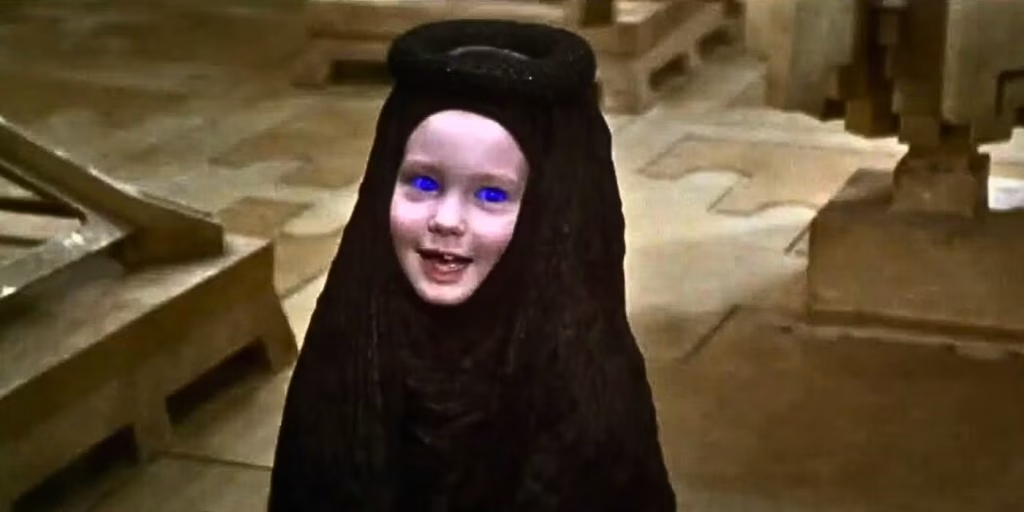
  • Alia, in a transport of ecstasy, holding aloft her crysknife as the Fremen overrun the imperial forces, a nightmarish composition by Lynch out of Bosch, all darkness, and a fully-formed witch who should be no more than a little girl, lit by fires and explosions, wrapped in Bene Gesserit robe and headpiece, with an expression on her face of triumph in slaughter that no little girl ever wore

This emphasis on the static over the kinetic is not so remarkable in an artist who, after all, began his career in—and remains committed to—the compositional rigors of painting, collage, and sculpture. But to see how it relates to folding space, we must further illuminate this concept of traveling without moving.

Read More “David Lynch Folds Space: Because He Is the Kwisatz Haderach!…”
Posted in: by Robert C. Cumbow, Contributors, David Lynch, Film Reviews

Review: Eraserhead

[Originally published in Movietone News 58-59, August 1978]

While an attendant whose deformed face and skin make him look like the Elephant Man pulls levers like those that start an amusement park ride, an ectoplasmic spermatozoon plunges squirming into a pool, making its way toward a globe that gradually crumbles, until we take the viewpoint of that globe and find ourselves sliding through a hair-rimmed aperture into a bright white beyond. Conception and birth, right? But of what?

Every time you think you’ve got hold of Eraserhead, you haven’t. A curly-haired macrocephalic strolls zombielike through a surreal landscape that is both identifiably urban and suggestively a macrophotograph of some portion of human anatomy. Lights come on but don’t light anything up; the bars of a radiator part like curtains to reveal a dancing woman on a tile stage; a manmade roast chicken no bigger than a fist squirms and bleeds when someone tries to carve it; a man and woman live with their hideous birdlike baby in a dingy flat whose floors and shelves are covered with some tangled, decaying fibrous matter—all of this against a soundtrack of incessant pounding, hissing, squeaking noises, and in the most frightfully claustrophobic black-and-white you’ve ever seen.

If you really give yourself to the film (and there’s a point beyond which it’s pretty hard not to), you pretty soon find yourself shifting a little, seeking out the reassuring glow of the exit light or suppressing the impulse to say to your neighbor “I gotta find some way outta here!” I don’t subscribe to the notion that seeing a film—or any work of art—can damage the viewer; but if anyone could demonstrably suffer permanent damage from seeing a film, there’s a good chance that the film would be Eraserhead. I saw it, and count myself among the walking wounded. The film makes all other so-called “dream” films pale by comparison: it is the most thoroughly oneiric—in fact, literally nightmarish—film I’ve ever seen: vivid, disorienting, captivating, stirring in me terrors whose names I don’t even know. From the field of the personal (or “underground”) film, where there is so much self-indulgent crap, and so much more careless fakery, Eraserhead emerges as a truly subversive film. It gets personal with the viewer in ways so intimate, so embedded in the private recesses of consciousness you wouldn’t have thought it possible. Who is this David Lynch and how does he know? This is what madness might be like, he makes you think, this oppressive absurdity, now funny, now scary, now just plain weird, but making a kind of sense that has nothing at all to do with reason. Believe it: Eraserhead is The Real Thing.

© 1978 Robert C. Cumbow

ERASERHEAD
Direction, screenplay, special effects, editing, production: David Lynch. Camera and lighting: Fred Elmes, Herbert Caldwell.
The players: John Nance, Charlotte Stewart, Allen Joseph, Jeanne Bates.

A pdf of the original issue can be found here.

Posted in: by Sean Axmaker, Contributors, David Lynch, DVD

Lynch Mob: Happy Birthday to the Maverick Weaver of American Nightmares

[Originally published January 10, 2011]

David Lynch, the once boyish maverick of underground visions and the nightmares under the façade of normalcy, turned 65 this week. A little older, a little grayer but still making films the only way he knows how: on his own terms. I had the good fortune to interview Lynch a few years ago, when he financed, produced and distributed Inland Empire outside the studio system. “It’s mostly common sense making films,” he explained. “If you can get your film into a theater, that’s all you need. And now you can make your own DVDs. If you have a conduit to stores, you put them down that conduit. Again, it’s a lot of common sense.”

Laura Dern in ‘Inland Empire.’ Photo credit: Absurda

Kim Morgan celebrated the birthday boy at Sunset Gun by revisiting her essay on Mulholland Dr.: “the man gets what drives our subconscious, our sweet dreams, our nightmares.”

I’ll chime in by picking out five more of my favorite Lynch films (plus his paradigm-changing TV series as a bonus) from thirty years of filmmaking: his strangest, most visionary and most perversely beautiful journeys through the curdled brick road of his mind. And all available on home video, in some cases in DVD releases produced by Lynch himself.

Eraserhead (1977) (Absurda)

“In heaven, everything is fine,” but in Eraserhead nothing is fine. It’s grim, disturbed, mutated, claustrophobic, a world that appears to be unraveling—or, more accurately, decaying—before our eyes. Jack Nance stars as the doughy, dim husband who escapes his grimy, droning life by watching the icky mutant cabaret that plays under his radiator. That’s as clear a description of the plot you’re bound to get. This is an existence where dinner squirms to get away as it’s being carved up and the newborn offspring of a dumbstruck couple is a freaky chicken baby that mewls and cries until it drives the maternal impulses right out of its horrified mother. Lynch shot the film over the course of a year with a loyal cast and crew that, at times, lived with Lynch on the very set of the film. There was nothing like it when it emerged in 1977 and became the quintessential midnight movie experience. See today, it is pure, primordial Lynch: a nightmare world of industrial slums and alienated folk, set to a soundtrack of noise that gets under your skin, your nails and your skull. Robert Cumbow came as close to anyone in capturing the experience in a review he wrote in 1978: “This is what madness might be like, he makes you think, this oppressive absurdity, now funny, now scary, now just plain weird, but making a kind of sense that has nothing at all to do with reason.”

It’s fitting that Lynch’s first feature, which he produced independently, is also the first DVD that he produced through his own label, Absurda. He personally supervised the transfer and the digital master and he participated in the documentary featurette “Stories,” which is centered around Lynch discussing the making of the film. For most directors this wouldn’t be anything special, but Lynch had quite conspicuously made himself absent from the supplements of studio-produced DVDs of his work in the past. This was the first time he recorded an interview specifically for the home video release of one of his films. It apparently was painless enough, for it wasn’t his last.

Read More “Lynch Mob: Happy Birthday to the Maverick Weaver of American Nightmares”