Gladiator, a blockbuster-budgeted behemoth about ancient Rome, begins with a lyrical closeup of a man’s hand rippling through the wheat in a sun-dappled field. Yes, this has the look of director Ridley Scott, in that exciting/maddening way of his: it’s an image that could come from a tone poem, or from a TV commercial. Scott has always had both sides to his directorial personality, which I think is why I have a hard time referring to Alien and Blade Runner as classics (having never gotten over the thud of disappointment I felt on their opening days). In fact, for a highly regarded filmmaker, Scott has an awful lot to answer for, including G.I. Jane, 1492, and that horned fantasy Legend.
Joshua Connor (Russell Crowe) is a dowser, a man who can find water in the Australian desert—a talent he will later employ when he goes searching for the bodies of his three sons, all lost on the same day in the disastrous World War I battle of Gallipoli. This supernatural touch isn’t really necessary to the film’s plot, and it’s a curious choice for Crowe (this is his directing debut). Part of Crowe’s immense credibility as an actor is how grounded he is—woo-woo stuff is really not for him. But the mystical hint is a sign of the film’s reach for significance, and of Crowe’s desire to say a few things while telling a very sincere story.
The Water Diviner follows Connor to Turkey, newly stripped of its status as the Ottoman Empire and now (in 1919, that is) overrun by British troops searching the Gallipoli battlefield.
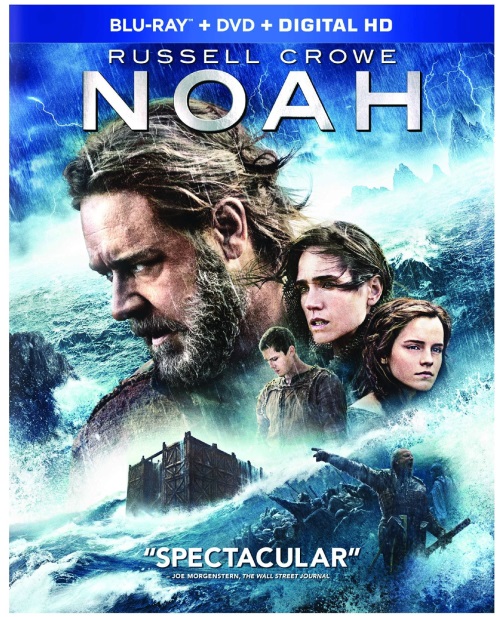
Darren Aronofsky takes a very different approach to the Biblical epic in Noah (Paramount, Blu-ray, DVD, VOD) a film both earthy and mystical. This isn’t the Old Testament prehistory we’ve seen before—Aronofsky draws from both Christian and Jewish religious texts to fill out the story (which is actually quite short in the Bible) and offers bleak, poisoned world before the flood quite different from the Mediterranean deserts and forests of previous films—and it accomplishes something quite powerful, vivid and unexpected as a result.
Russell Crowe is Noah as God’s moral man, the last of the faithful who lives his life as Earth’s steward. He keeps his family (wife Jennifer Connelly, sons Logan Lerman and Douglas Booth, daughter-in-law Emma Watson) away from Cain’s offspring (Ray Winstone as a brutal tribal warlord) and the despoilers of the Earth. The creator (as God is called throughout the film) doesn’t speak in the dramatic voice so familiar to other films. He communicates through visions and they are violent, confusing things that Noah must take on faith. Noah undertakes his task as a solemn duty, helped by a race of rock-like beings who were once angels that were cast out of heaven and anchored to Earth.
Ancient mythology and modern cosmology come together in the story of Genesis, told in Noah’s own words and illustrated with imagery reminiscent of Cosmos, a wedding science and religion in a way respectful of both. Even the Ark itself looks different than we’re used to, which is curious considering it is designed according to the dimensions specified in the Bible (see the infographic below for details on scaling the ark, the flood and other details). It’s an epic canvas for a human story and Aronofsky shows great respect for the faith of the source while taking a creative approach to dramatizing the story and the world.
On Blu-ray and DVD. Aronosky shot much of the film in Iceland to get that barren, blasted landscape and he explores the location in the featurette “Iceland: Extreme Beauty.” It’s exclusive to the Blu-ray editions of the film, as are two addition featurettes: “The Ark Exterior: A Battle for 300 Cubits” and “The Ark Interior: Animals Two By Two.” The Blu-ray also features bonus DVD and UltraViolet digital copies of the film.
The new movie Noah, director Darren Aronofsky’s $130 million epic retelling of the story of Noah’s Ark and the Great Flood, carries this advisory: “While artistic license has been taken, we believe that this film is true to the essence, values and integrity of a story that is a cornerstone of faith for millions of people worldwide.”
Russell Crowe in Darren Aronofsky’s ‘Noah’
Noah has been banned in some Middle Eastern countries, and attacked by some Christian critics for taking liberties with scripture. Aronofksy told the New Yorker that “Noah” is “the least biblical biblical film ever made,” hardly the kind of comment to calm the faithful
Fair disclaimer, but it’s likely not one that will reach all filmgoers who see “Noah” with the expectation that the Aronofsky’s version will closely mirror the biblical series of events. For a little scriptural background and film fact-checking, Steven D. Greydanus, a film critic for the National Catholic Register and his own website, Decent Films, and a Bible student at the Archdiocese of Newark viewed the film before its release. The experts’ general verdict: there’s a lot that closely mimics the epic story, but some liberties are taken. Warning: Spoilers for the film obviously follow.
Is the word God missing from the film as some critics have charged?
No, says Greydanus. “For the most part, God is referred to in the film as ‘the Creator’ and this is a creative choice that I think does a lot for the film. It helps to defamiliarize the language somewhat, it makes the figure of God a little more mysterious to us.” But His name is clearly spoken when Ham, second son of Noah, says to Tubal-cain: “My father says there can be no king. The Creator is God.”
There has always been something a little Old Testament about Darren Aronofsky’s films, so maybe it makes sense that he’s going back to the source for his new movie. The director of Black Swan and The Wrestler is on board with the original disaster epic: Noah and the flood. Armed with the latest in computer-generated effects, Aronofsky is quite serious about this telling of the biblical tale — even grim, you might say. Noah, played by a glowering Russell Crowe, is a man convinced that his Creator plans to drown the world.
Curiously, Aronofsky shrugs off a couple of staples of the Sunday-school rendition of the story: Noah’s social ostracizing for believing in the flood (and the resulting gotcha when all the nonbelievers get soaked), and the majesty of the animals heading two-by-two into the ark. This Noah focuses on a moral fable.
Contains information related to marketing campaigns of the user. These are shared with Google AdWords / Google Ads when the Google Ads and Google Analytics accounts are linked together.
90 days
__utma
ID used to identify users and sessions
2 years after last activity
__utmt
Used to monitor number of Google Analytics server requests
10 minutes
__utmb
Used to distinguish new sessions and visits. This cookie is set when the GA.js javascript library is loaded and there is no existing __utmb cookie. The cookie is updated every time data is sent to the Google Analytics server.
30 minutes after last activity
__utmc
Used only with old Urchin versions of Google Analytics and not with GA.js. Was used to distinguish between new sessions and visits at the end of a session.
End of session (browser)
__utmz
Contains information about the traffic source or campaign that directed user to the website. The cookie is set when the GA.js javascript is loaded and updated when data is sent to the Google Anaytics server
6 months after last activity
__utmv
Contains custom information set by the web developer via the _setCustomVar method in Google Analytics. This cookie is updated every time new data is sent to the Google Analytics server.
2 years after last activity
__utmx
Used to determine whether a user is included in an A / B or Multivariate test.
18 months
_ga
ID used to identify users
2 years
_gali
Used by Google Analytics to determine which links on a page are being clicked
30 seconds
_ga_
ID used to identify users
2 years
_gid
ID used to identify users for 24 hours after last activity
24 hours
_gat
Used to monitor number of Google Analytics server requests when using Google Tag Manager
1 minute
Marketing cookies are used to follow visitors to websites. The intention is to show ads that are relevant and engaging to the individual user.
A video-sharing platform for users to upload, view, and share videos across various genres and topics.
Registers a unique ID on mobile devices to enable tracking based on geographical GPS location.
1 day
VISITOR_INFO1_LIVE
Tries to estimate the users' bandwidth on pages with integrated YouTube videos. Also used for marketing
179 days
PREF
This cookie stores your preferences and other information, in particular preferred language, how many search results you wish to be shown on your page, and whether or not you wish to have Google’s SafeSearch filter turned on.
10 years from set/ update
YSC
Registers a unique ID to keep statistics of what videos from YouTube the user has seen.
Session
DEVICE_INFO
Used to detect if the visitor has accepted the marketing category in the cookie banner. This cookie is necessary for GDPR-compliance of the website.
179 days
LOGIN_INFO
This cookie is used to play YouTube videos embedded on the website.