Why isn’t Richard Lester more celebrated? An American who made his home in England, Lester earned an Oscar nomination for The Running Jumping & Standing Still Film (1959), a lark he made with Peter Sellers and Spike Milligan and others, made his reputation as a fresh, innovative filmmaker with Beatles rock and roll romp A Hard Day’s Night (1964), and proved his versatility with the acidic drama Petulia (1968), the comic swashbucklers The Three Musketeers (1973) and The Four Musketeers (1974), and the melancholy Robin and Marian (1976).
Kino Lorber has just released three of Lester’s British film on Blu-ray for the first time on their Studio Classics label, including one of his best.
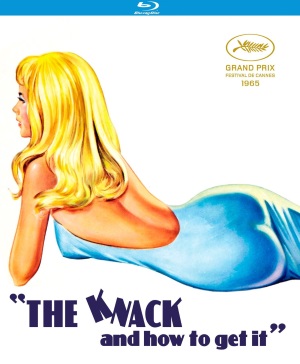
Fresh from the playfully exuberant A Hard Day’s Night, which set the bar for rock and roll cinema and inspired the modern music video, Richard Lester continued the same acrobatic, tongue-in-cheek style in The Knack… and How to Get It (Kino Lorber Studio Classics, Blu-ray), his adaptation of Ann Jelico’s lightweight play “The Knack,” creating a delightfully frivolous take on swinging London and the sexual revolution.
[Originally published in Movietone News 49, April 1976]
Richard Lester is sitting in the study of his house in Surrey “looking out over a garden filled with rain and daffodils.” He was raised in Philadelphia but he has spent nearly half of his 42 years in England and he has no particular wish to return to the States. England has given him his career, his wife, his children and most of his friends, for all of which he is most grateful. In addition, he has a rather perverse fondness for English weather.
In the middle Sixties, Lester seemed unstoppable. He had made, consecutively and within the space of a few years, four highly profitable films for United Artists, films whose box-office clout was exceeded only by their glowing critical reception. He turned his attention then to a couple of projects which, although they were much more personal, seemed to him to have only slightly less popular potential. He was wrong. How I Won the War, Petulia, and The Bed-Sitting Room—all brilliant, unique films—failed miserably at the box office. From 1968 to 1973 Lester watched forlornly as a dozen potential projects fell through for one reason or another. He occupied himself in the long interim making television commercials for European producers. When the Salkind family troika approached him with the prospectus for a version of Dumas’ The Three Musketeers, the drought broke.
Richard Lester
Two films were made from that book. The first, The Three Musketeers: The Queen’s Diamonds, was released in the spring of 1974 and did excellent business during the summer and fall; the second, The Four Musketeers, The Revenge of Milady, was scheduled for release the following spring—shortly after the ensuing interview—and promised to do as well. Hardly a month after he had finished post-production work on these, Lester was offered, and took, the job of directing Juggernaut—which was in release barely six months after he began work on it. Andrew Sarris, who was later to contradict many reviewers in preferring The Four Musketeers to The Three, wrote of Juggernautthat it “comes very, very close to being the best film I have seen all year under any auspices. It is a thriller, yes, but it is much, much more, besides.” Just .as Juggernautwas being released, Lester began work on a long-deferred project, Royal Flash.
Both Juggernaut and the Musketeers films were essentially commercial projects conceived by their producers rather than Lester, but he nevertheless managed to inject his own brand of irony and wit into them, making them considerably more interesting than they otherwise might have been. After all, Lester is an old hand at the battle of the genres, having wittily satirized the Donen-Minnelli musical with A Funny Thing Happened on the Way to the Forum, reconstructed the melodrama in Petulia, and destroyed for all time the war film in How I Won the War.
Contains information related to marketing campaigns of the user. These are shared with Google AdWords / Google Ads when the Google Ads and Google Analytics accounts are linked together.
90 days
__utma
ID used to identify users and sessions
2 years after last activity
__utmt
Used to monitor number of Google Analytics server requests
10 minutes
__utmb
Used to distinguish new sessions and visits. This cookie is set when the GA.js javascript library is loaded and there is no existing __utmb cookie. The cookie is updated every time data is sent to the Google Analytics server.
30 minutes after last activity
__utmc
Used only with old Urchin versions of Google Analytics and not with GA.js. Was used to distinguish between new sessions and visits at the end of a session.
End of session (browser)
__utmz
Contains information about the traffic source or campaign that directed user to the website. The cookie is set when the GA.js javascript is loaded and updated when data is sent to the Google Anaytics server
6 months after last activity
__utmv
Contains custom information set by the web developer via the _setCustomVar method in Google Analytics. This cookie is updated every time new data is sent to the Google Analytics server.
2 years after last activity
__utmx
Used to determine whether a user is included in an A / B or Multivariate test.
18 months
_ga
ID used to identify users
2 years
_gali
Used by Google Analytics to determine which links on a page are being clicked
30 seconds
_ga_
ID used to identify users
2 years
_gid
ID used to identify users for 24 hours after last activity
24 hours
_gat
Used to monitor number of Google Analytics server requests when using Google Tag Manager
1 minute
Marketing cookies are used to follow visitors to websites. The intention is to show ads that are relevant and engaging to the individual user.
A video-sharing platform for users to upload, view, and share videos across various genres and topics.
Registers a unique ID on mobile devices to enable tracking based on geographical GPS location.
1 day
VISITOR_INFO1_LIVE
Tries to estimate the users' bandwidth on pages with integrated YouTube videos. Also used for marketing
179 days
PREF
This cookie stores your preferences and other information, in particular preferred language, how many search results you wish to be shown on your page, and whether or not you wish to have Google’s SafeSearch filter turned on.
10 years from set/ update
YSC
Registers a unique ID to keep statistics of what videos from YouTube the user has seen.
Session
DEVICE_INFO
Used to detect if the visitor has accepted the marketing category in the cookie banner. This cookie is necessary for GDPR-compliance of the website.
179 days
LOGIN_INFO
This cookie is used to play YouTube videos embedded on the website.


 Why isn’t Richard Lester more celebrated? An American who made his home in England, Lester earned an Oscar nomination for The Running Jumping & Standing Still Film (1959), a lark he made with Peter Sellers and Spike Milligan and others, made his reputation as a fresh, innovative filmmaker with Beatles rock and roll romp A Hard Day’s Night (1964), and proved his versatility with the acidic drama Petulia (1968), the comic swashbucklers The Three Musketeers (1973) and The Four Musketeers (1974), and the melancholy Robin and Marian (1976).
 [Originally published in Movietone News 49, April 1976]