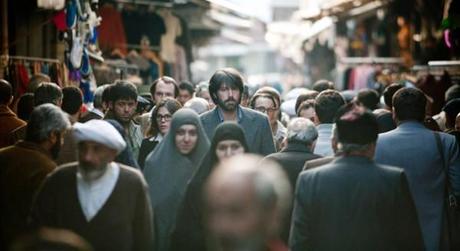
Argo (Warner), the third feature from actor-turned-director Ben Affleck, was released early in October, just before the traditional roll-out of high-toned dramas and Oscar-bait showpieces gets aggressively competitive, and debuted to glowing reviews, enthusiastic audiences, and impressive box-office. Pretty good for a real-life drama about the stranger-than-fiction rescue of the six Americans who escaped capture when Iranians stormed the U.S. Embassy and took American hostages. But then it’s a savvy picture that takes a few liberties with the historical record to create a nail-biter of an escape thriller.
It was an early Oscar favorite, then lost momentum as the season rolled ahead and competition heated up. For reasons still not clear, Ben Affleck was passed over as a Best Director nominee and even though the film snagged seven Oscar nominations – an impressive count by anyone’s standards – it seemed to have lost its luster. Then it caught its second wind: a Best Director award from the DGA, Best Director and Best Picture Golden Globes, an award for the ensemble cast from the Screen Actors Guild, and BAFTA wins for Best Picture and Best Director. Now, as handicappers tip “Argo” as for the Best Picture Oscar, it arrives on disc and digital delivery less than a week before the Academy Awards.
Awards hype aside, Argo is a terrific piece of filmmaking. Not Zero Dark Thirty brilliance or Life of Pi beauty, mind you, but a solid, well-made film with personality, humor, drama, tension, and a superb sense of time and place. Affleck and screenwriter Chris Terrio establish the era and the complicated history that created the Iranian situation smartly and efficiently, and Affleck seamlessly combines actual news footage with recreations that segue into the story at hand. And while I’m not convinced that the escape-movie contrivances that drive the film’s final act necessary to communicate the stakes of this mad plan, there is something oddly appropriate in the way this meeting of Hollywood fakery and true-story spycraft plays out like a movie.
Argo, the movie inspired by the 1979 Iran hostage crisis, is going to win the Academy Award as best picture of 2012. Go ahead, place that bet in your office Oscar pool, but don’t expect to reap much advantage, because everybody else is just as sure that Argo is going to win.
The signs are impossible to miss, or to deny. Like The King’s Speech a couple years back, and like The Artist the year after that, Argo has been sweeping the film industry’s pre-Oscar contests: the Producers Guild Award, the ensemble award from the Screen Actors Guild, “outstanding directorial achievement” from the Directors Guild (DGA), and the BAFTAs—the trophies from the British Academy of Film and Television Arts—for best picture and direction. Since many of the voters in those various contests are also members of the Hollywood academy, they’ve already vouchsafed a de facto peek at a lot of Oscar ballots.
There is, to be sure, a notable break with the usual pattern. Most years, the director of the movie about to be named best picture will be called to the podium to collect the Oscar for best direction. And much more often than not, that Oscar victory has been predicted by a DGA win. So we’re on track, right? Ben Affleck, star and director of Argo, won the DGA. Yes, but. Whereas the five nominees for the DGA and those for the best-director Oscar tend to be the same, or pretty much the same, this year only two of the DGA nominees made it onto the Oscar slate. And neither of them was Ben Affleck.
How and why this happened boggles the mind; we’ll probably never know. What we can say is that, far from blighting Argo‘s chances for winning best pic, the snubbing of its director seems to have inspired a backlash. Argo lovers are all the more determined to honor their movie, and mere Argo likers who might have been inclined to vote for one of the other eight best-picture nominees have swung aboard Argo. Also—as past best-director winners Robert Redford, Warren Beatty, Richard Attenborough, Kevin Costner, Clint Eastwood and Mel Gibson can tell you—the biggest voting bloc in the academy is the actors branch, and they like to see one of their own make good. That Affleck has made good as a director after often being belittled as an actor only adds to the payback fervor.
For the record, those other eight nominees for best picture are: Amour, a rare instance of a foreign-language film breaking into this category; Beasts of the Southern Wild, the fave rave among American independent films in 2012; DjangoUnchained, Quentin Tarantino’s expectedly outrageous foray into spaghetti-Western territory; LesMisérables, from the decades-long-running musical; Life of Pi, Ang Lee’s version of the “unfilmable” mystical novel; Steven Spielberg’s historical drama Lincoln (which leads with twelve Oscar nominations); SilverLiningsPlaybook, the best romantic comedy in living memory; and ZeroDarkThirty, Kathryn Bigelow’s distillation of the ten-year hunt for Osama bin Laden.
As for the directorial scorecard, only Ang Lee and Spielberg carry over from the DGA slate. MIA along with Affleck are fellow Directors Guild nominees Bigelow (winner three years ago for TheHurtLocker) and Tom “LesMiz” Hooper (winner two years ago for TheKing’sSpeech); their slots on the Oscar ballot have gone to Michael Haneke (Amour), David O. Russell (SilverLiningsPlaybook), and Benh Zeitlin (first-time director of Beasts of the Southern Wild).
We’ve spoken of Argo‘s conquest of industry awards (and don’t forget the goofy Golden Globes!), but it should be noted that Affleck’s crowd-pleasing movie barely showed up in critics-group award reckonings. In such contests, Bigelow/ZeroDarkThirty and Haneke/Amour mostly traded first-place honors, with Lincoln (though curiously not Spielberg) crowding for second position.
The discrepancy is easy enough to account for. Bigelow’s, Haneke’s and even Spielberg’s films are complex works of art that challenge audiences and then leave it up to those audiences to deal with the implications of what they’ve witnessed and experienced. Argo is a well-made movie with a fascinating (and mostly true) story to tell, of how six U.S. foreign service workers were exfiltrated from Tehran during the 1979 Iranian hostage-taking crisis, and when it’s over, it’s over. No resonance, no takeaway. An entertaining, quality movie, yes indeed, and there can never be an oversupply of those. But “best film”?
So, since it can’t be Ben Affleck (and the academy no longer allows write-in votes), who takes best director? It’s anybody’s guess. Spielberg has won twice already, and although Lincoln is much respected, I don’t get the sense people are excited about it. LifeofPi must be accounted an awesome technical achievement (the costar and most of the action is all CGI), but should it win Ang Lee a second Oscar? Haneke doesn’t make a wrong move with Amour and, denied the chance to vote for Bigelow, I guess I’d go with him. David O. Russell isn’t my kind of director visually, but SilverLiningsPlaybook is the first movie in 31 years to score nominations in all four acting categories, and he’s gotta rate for that. Zeitlin doesn’t belong here.
Best actress: SilverLiningsPlaybook‘s Jennifer Lawrence (“Hey!”) is the favorite, and certainly mine, but it will be deeply moving if Emmanuelle Riva, of Amour, celebrates her 86th birthday with an Oscar win; hers is one of the bravest performances ever. Also plenty worthy is Jessica Chastain as the fierce CIA analyst in Zero Dark Thirty. Inappropriate: Naomi Watts, in TheImpossible (but not enough of it); Quvenzhané Wallis, best thing about Beasts of the Southern Wild (but a kid).
Best actor: Daniel Day-Lewis, Lincoln—take it to the bank.
Best supporting actress: I don’t see how anything stops Anne Hathaway, Les Misérables, though I wish something would. Sally Field deserves the Oscar for her Mary Todd Lincoln, and Helen Hunt deserves another for TheSessions.
Best supporting actor: His lovely work as the sports-obsessed Philly father in Silver Linings Playbook is the first performance Robert De Niro has woken up to give in years. He could even win (and I cast my top National Society of Film Critics vote for him). But keep an eye on Tommy Lee Jones in his rather too showcase part in Lincoln. Philip Seymour Hoffman, TheMaster, and Christoph Waltz, Django Unchained, both world-beaters, seem out of place in the supporting category. Alan Arkin’s vaudeville turn in Argo was easy meat.
Further remarks plus notes from the battlefield next week. The Oscars will be awarded this coming Sunday, Feb. 24, 5:30 p.m. on KOMO-4.
SIDEBAR
Ah, the glories of infinitely expandable space in online editions … and so, a sidebar.
It seemed, still seems, unthinkable that anyone could deprive Tony Kushner of the Oscar for his Lincoln screenplay, which raises subtlety to epic proportions. And yet Kushner shares a category with Chris Terrio, the screenwriter of Argo, and if this turns out to be one of those sweep years when Academy voters just don’t know when to quit, it becomes horribly thinkable that Kushner could lose. And speaking of category … Adapted Screenplay? I know that Doris Kearns Goodwin’s wonderful Lincoln history Team of Rivals is technically the source of Lincoln, but to consider Kushner’s script as anything but an original seems picayune. Also nominated: Beasts of the Southern Wild, Life of Pi, Silver Linings Playbook.
Original Screenplay is stronger yet: Amour (Michael Haneke), Django Unchained (Quentin Tarantino, who won the BAFTA), Flight (John Gatins), Moonrise Kingdom (Wes Anderson & Roman Coppola), Zero Dark Thirty (Mark Boal). Shut your eyes and throw for the dart board, you’re going to hit a winner no matter what. My preference: Haneke for Amour, then the Moonrise Kingdom boys.
Amour will also almost certainly be announced in the Foreign-Language Film category. Of course, predicting that award is dicey because of the peculiar, but entirely appropriate, rules restricting who gets to vote for it. Only members on record as having seen all five nominees may mark a ballot, so even if one film has loomed largest in publicity and critical acclaim, it’s possible that the all-but-unseen (by everybody else) little nominee from Upper Volta is going to pull an upset. No, there’s no film from Upper Volta in this year’s batch, but there are Kon-Tiki (Norway), No (Chile), A Royal Affair (Denmark), and War Witch (Canada). Amour, set in France with dialogue spoken in French by French cinema acting royalty, is technically an Austrian film.
In Film Editing, William Goldenberg will take home an Oscar—but for Argo or the more meticulously shaped Zero Dark Thirty, on which he shares credit with Dylan Tichenor? Other films nominated: Life of Pi, Lincoln, Silver Linings Playbook.
It is grotesque that Roger Deakins, arguably the world’s greatest living cinematographer, has no Oscar for his mantel. Skyfall marks his tenth nomination, and is (top this for trivia) the first James Bond film ever nominated for Cinematography. In Deakins’ favor, Argo isn’t a factor here. However, Life of Pi is, and that film is continuously stunning to behold. However (like 2009 Cinematography winner Avatar), it’s a movie wherein a lot of what we see is the work of Visual Effects people of various specializations. What cinematography there is is Claudio Miranda’s. Also nominated: Anna Karenina, Django Unchained, Lincoln. Roger and out.
Original Song, Costume Design, Sound Mixing, etc. are not in my wheelhouse. And anyway, I always do abysmally in Oscar pools. —RTJ
Expanded version of a column that appeared in Queen Anne & Magnolia News, Feb. 20, 2013
I have a hunch about what’s helped keep Argo’s awards slowly, stubbornly piling up inside Hollywood: Benghazi and its seemingly interminable fallout.
Ben Affleck in ‘Argo’
Argo opened one month and a day after that murderous attack. It was a month that reshaped what we knew about the realities of “diplomacy” when, in the presence of the President and the Secretary of State, the bodies of our Ambassador to Libya and three men who tried to save him were returned to their families and to a largely uncomprehending country.
And as we began to think about what it is that diplomats do, Argo arrived to show us. It was deadly-real and it was Hollywood-real; it had the look of newsreel footage and a grand, bogus bigger-than-life finale, and at its core were six, human, identifiable characters – diplomats all.
At its most deadly serious, Argo was sound for sound, action for action, what happens when an American embassy (consulate, mission) is overrun in a decidedly unfriendly country. Even when Benghazi became political attack fodder, Argo’s resonance of resilience under fire lingered.
I started to describe why Argo struck me as brilliant and almost unendurable, all at once, but that’s silly. Just drop everything and go. For such a full-throttle, gripping, movie-goer’s-movie, it has depths that linger — certainly at this house.
I haven’t been writing for a while. Even before the September 11th attacks in Benghazi, with the death of Ambassador Chris Stevens and three others, I’ve been reading, almost every day, reports from a world that I am intimately connected to, yet necessarily apart from, our Foreign Service.
Most of my friends know that the most far-flung of the three daughters joined the Foreign Service just over three years ago. She began working in Bogota, came back to D.C. this Fall for training as a Consular Officer and when that’s finished, she goes to Ciudad Juarez, Mexico. With, of course, her husband and their three cats, the Tabbies.
At the same time that I followed every test, every setback and surge forward on her blog, I began to browse over at the Tabbies’ lower right-hand column, where she lists other FS blogs she follows.
They are the damndest mash-up imaginable: blogs so dense with acronyms that I don’t venture across their threshholds; ones fuming at a bureaucracy that seems to make things harder, not easier, and ones with pretty imaginative examples of coping calmly with what you and I might see as staggering obstacles.
Contains information related to marketing campaigns of the user. These are shared with Google AdWords / Google Ads when the Google Ads and Google Analytics accounts are linked together.
90 days
__utma
ID used to identify users and sessions
2 years after last activity
__utmt
Used to monitor number of Google Analytics server requests
10 minutes
__utmb
Used to distinguish new sessions and visits. This cookie is set when the GA.js javascript library is loaded and there is no existing __utmb cookie. The cookie is updated every time data is sent to the Google Analytics server.
30 minutes after last activity
__utmc
Used only with old Urchin versions of Google Analytics and not with GA.js. Was used to distinguish between new sessions and visits at the end of a session.
End of session (browser)
__utmz
Contains information about the traffic source or campaign that directed user to the website. The cookie is set when the GA.js javascript is loaded and updated when data is sent to the Google Anaytics server
6 months after last activity
__utmv
Contains custom information set by the web developer via the _setCustomVar method in Google Analytics. This cookie is updated every time new data is sent to the Google Analytics server.
2 years after last activity
__utmx
Used to determine whether a user is included in an A / B or Multivariate test.
18 months
_ga
ID used to identify users
2 years
_gali
Used by Google Analytics to determine which links on a page are being clicked
30 seconds
_ga_
ID used to identify users
2 years
_gid
ID used to identify users for 24 hours after last activity
24 hours
_gat
Used to monitor number of Google Analytics server requests when using Google Tag Manager
1 minute
Marketing cookies are used to follow visitors to websites. The intention is to show ads that are relevant and engaging to the individual user.
A video-sharing platform for users to upload, view, and share videos across various genres and topics.
Registers a unique ID on mobile devices to enable tracking based on geographical GPS location.
1 day
VISITOR_INFO1_LIVE
Tries to estimate the users' bandwidth on pages with integrated YouTube videos. Also used for marketing
179 days
PREF
This cookie stores your preferences and other information, in particular preferred language, how many search results you wish to be shown on your page, and whether or not you wish to have Google’s SafeSearch filter turned on.
10 years from set/ update
YSC
Registers a unique ID to keep statistics of what videos from YouTube the user has seen.
Session
DEVICE_INFO
Used to detect if the visitor has accepted the marketing category in the cookie banner. This cookie is necessary for GDPR-compliance of the website.
179 days
LOGIN_INFO
This cookie is used to play YouTube videos embedded on the website.


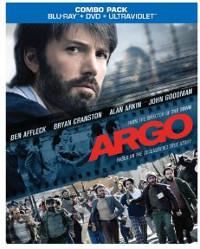 Argo (Warner), the third feature from actor-turned-director Ben Affleck, was released early in October, just before the traditional roll-out of high-toned dramas and Oscar-bait showpieces gets aggressively competitive, and debuted to glowing reviews, enthusiastic audiences, and impressive box-office. Pretty good for a real-life drama about the stranger-than-fiction rescue of the six Americans who escaped capture when Iranians stormed the U.S. Embassy and took American hostages. But then it’s a savvy picture that takes a few liberties with the historical record to create a nail-biter of an escape thriller.