Posted in: by Sean Axmaker, Directors, Essays, Film Festivals

Yasujiro Ozu on TCM in May

The oft-quoted cliché about Yasujirō Ozu is that he is the most “Japanese” of Japanese directors, a somewhat problematic claim (is there really a single ideal expression of Japanese character?) that nonetheless strives to describe a style and sensibility that rejected the cinematic influences of the West. His evolution is all the more fascinating given his love of Hollywood films as a voracious young film buff. His film career began in the early 1920s as an assistant cameraman at Shochiku, Japan’s biggest film studio. He remained at Shochiku his entire career, working his way up to assistant to director Tadamoto Okubo before making his directorial debut in 1927. The film, the only period piece of his career, has not survived. Ozu made every type of genre in those early years, from lighthearted college comedies to crime dramas and romantic melodramas to social dramas, turning out as many as six features a year. But, he really found his voice in shomin-geki, which translates to “home drama,” stories that explore the everyday lives of middle and lower middle-class citizens.

Where so many of his contemporaries delved into adventures and elegant period dramas, Ozu’s films are contemporary to his times. From his silent films in the early 1920s to his final film in 1962, An Autumn Afternoon, he set his quietly understated family dramas and modest comedies in the homes and workplaces of everyday citizens trying to make a life for themselves and their children. His films are a veritable survey of Japanese society from the late 1920s to the early 1960s, exploring themes of social expectations, familial responsibility, sacrifice and the collision of traditional culture and modern life, from The Depression through The War to the transition of a new democracy and Western-style economy.

TCM celebrates the legacy of Yasujirō Ozu, proclaimed by film critic and historian David Bordwell as “the greatest director ever to work in the history of cinema,” with 20 features plus the TV premiere of a new documentary on the legendary filmmaker.

Continue reading at TCM

Posted in: by Sean Axmaker, Film series

Roger Corman on TCM in April

Roger Corman left behind a legacy unmatched by filmmakers of his (or, for that matter, any) generation when he passed away in 2024 at the age of 98. In addition to directing over 50 films, he produced almost 500 features, created and ran two production companies and hired young talent in all facets of the business, both in front of and behind the cameras. He was dubbed “King of the B-movies” for his cheap productions and cost-cutting tricks, but he had an eye for talent and provided invaluable practical experience to hungry young artists willing to work long hours for small paychecks. Among the graduates of the “Corman School” are such luminaries as Martin Scorsese, James Cameron, Jack Nicholson, Robert Towne, John Sayles, Gale Anne Hurd and Jonathan Demme. TCM celebrates the magnate with four nights spanning his career. The first two nights feature films directed by Corman, and the following two highlight the directors who came up under his tutelage.

Friday, April 3

Peter Bogdanovich, Joe Dante, and Ron Howard are among the filmmakers who share their stories in Roger Corman: The Pope of Pop Cinema (2021), a French documentary that sketches out the defining contradictions of the ambitious young director who gave up on the studios and created his own career as an independent filmmaker. The rest of the night dives into a sampling of his early career as director, including a pair of films that have become cult classics.

Continue reading on the TCM website

Posted in: by Sean Axmaker, Contributors, Film Reviews, Pre-code Cinema, Television

Channeling Movies: Sex and Sin on Pre-Code Fridays on Turner Classic Movies

‘Red Dust’

Turner Classic Movies is turning all the Fridays in September over to films from that brief period in the early thirties when the studios thumbed their collective noses at the toothless Production Code and pushed the boundaries of sex, violence, and bad behavior without judgment or consequences in film after film. The iron boot of censorship came down in 1934 and stomped out all that deliciously salacious content, but for a few years Hollywood acknowledged and even flaunted sex between consenting adults (married or not). The films from this era were branded “Forbidden Hollywood” when they were rediscovered and revived for audiences in the 1990s, but today they are better known as Pre-Code. Turner Classic Movies has four full Fridays full of forbidden Pre-Code delights.

While there are gems aplenty throughout the month, I’ll spotlight a few of the most interesting and audacious rarities and lesser-known glories, including two from the coming Friday line-up.

Set those DVRs now!

Friday, September 5:

Safe in Hell (1931) – Think of this as a kind of B-movie riff on Sadie Thompson (the original bad girl in the tropics melodrama) directed with a merciless brutality by William Wellman. It stars the largely forgotten Dorothy Mackaill as a scuffed-up, street-smart answer to Miriam Hopkins and she is amazing as the hooker who is whisked off to a Caribbean island to flee a murder charge. The film’s title is no exaggeration; imagine Casablanca as a lice-infested backwater run by mercenary opportunists and filled with the sleaziest criminals to escape a manhunt. They all take their shot at seducing Mackaill, the sole white woman in this island prison, and she shoots them all down with the brash directness of an experienced urban doll who has spent her life fending off passes. Yet somehow the film manages to give them all a shot at redemption when she is tried for murder (it’s a different murder, and yet the same one, in the crazy logic of the melodrama contrivances) and they line up in her defense. Wellman it snappy and sassy as he winds the story from the cynical to the sentimental to the spiritual with equal commitment.

Dorothy Mackaill is hardly ‘Safe in Hell’

Read More “Channeling Movies: Sex and Sin on Pre-Code Fridays on Turner Classic Movies”

Posted in: by Sean Axmaker, Contributors, Documentary, Film Festivals

Channeling Movies: The ultimate movie history class runs Monday nights on Turner Classic Movies

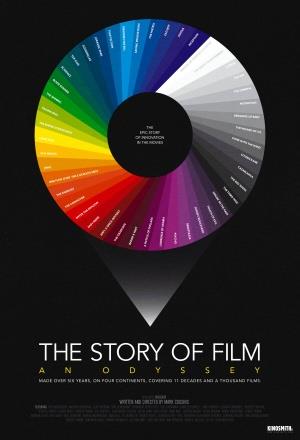
In The Story Of Film: An Odyssey, filmmaker and film historian Mark Cousins takes an unconventional, expansive, and almost exhaustive approach to the history of cinema, from the first moving images to modern movies. His 15-hour documentary series is an ambitious attempt to encapsulate cinema, from birth to the present, as practiced all over the world, and emphasizes innovation, expression, and the cross-cultural fertilization of ideas spanning the entire globe. But Cousins is not just an educator, he’s a missionary sharing the beauty and magic of cinema: “A lie to tell the truth.”

The series is on DVD and available to stream on Netflix, and starting on Monday, September 2, Turner Classic Movies will be rolling out the documentary with a new episode every Monday through December 9. Accompanying the series is a festival of films that Cousins features in the respective chapters, playing every Monday and Tuesday night for the first nine weeks of the series (and then Mondays only for the final six weeks).

The series opens with a selection of landmark works of early cinema by the Edison studios, the Lumière Bros., George Melies, and Alice Guy-Blaché, followed by early feature films from D.W. Griffith (including Birth of a Nation) and others.

According the TCM, 119 films will be screened in conjunction with The Story of Film, 30 of them making their respective TCM debuts, from Luis Buñuel & Salvador Dalí’s Un Chien Andalou (1928) and Kenji Mizoguchi’s Japanese classic Osaka Elegy (1936) (both Tuesday, September 17) to Jane Campion’s The Piano (1993) and Nuri Bilge Ceylan’s Climates (2006) from Turkey (in December).

Continue reading at MSN Hitlist