[Originally published in Movietone News 57, February 1978]
I was going to put Looking for Mr. Goodbar on my end-of-the-year list as “Best Film of 1967.” But although Richard Brooks’ self-consciously flashy techniques are at least that dated, I think even a decade ago his shallow, cheating approach to both subject and audience would have been seen for what it is. Several times in the course of the film, Brooks segues his narrative line into a surprising but dead-end sequence that—after a shock-cut back to reality—proves to have been a fantasy of the main character, Terry Dunn. The first couple of times this happens, the audience has no basis for regarding the sequence as fantasy, since Terry is never portrayed as a woman who can’t tell the difference between reality and fantasy. Even later, the audience picks up on the cutaways to fantasy only because by now it is on to Brooks’s tricks. Never does the device have any integral bearing on the film’s theme or style.
Once Upon A Time in America: Extended Director’s Cut (Warner, Blu-ray, DVD, Digital HD) is Sergio Leone’s portrait of a 20th century American success story as a gangster epic of greed, loyalty, betrayal, and power, seen through the haze of an opium high. Shuffling back and forth through the century, from New York’s East side in 1923, where scrappy street kids Noodles and Max form a partnership that will blossom into a mob empire, though the glory days of the depression cut short by mob warfare, to 1968, when the graying Noodles (Robert DeNiro) returns from a 35 year exile to the scene of the crime to discover what really happened to his partner and best friend Max (James Woods) all those years ago, this is Leone’s most passionate, elegant, brutal, and elegiac film. William Forsythe and James Hayden complete the gangster quartet, with Joe Pesci and Burt Young as gangster cohorts. Elizabeth McGovern, Treat Williams, Tuesday Weld, Danny Aiello, and young Jennifer Connelly co-star. Ennio Morricone’s score is one of his most haunting and beautiful.
The film was originally released in the US in a butchered version cut by over an hour and torn from its evocative time-shifting structure to a traditional linear narrative. It was restored to its 229-minute European cut decades ago but earlier this year it was expanded with an additional 22 minutes of footage that Leone was forced to cut out before its Cannes premiere in 1984. The added footage was taken from workprint material and, faded and sometimes damaged, stands out against the well-reserved and beautifully-mastered material from the previous cut. Among the restored sequences is a legendary scene with Louise Fletcher as a cemetery director, previously only glimpsed in publicity stills (you can see the clip below). Susan King goes over the history of the cuts and the scope of the restoration in an article for the Los Angeles Times.
It’s available on DVD and Blu-ray along with an excerpt from the documentary Once Upon a Time: Sergio Leone and trailers. A deluxe Blu-ray Book edition also features the previous Blu-ray release of the 229-minute European cut, which features commentary by Richard Schickel, and an UltraViolet Digital HD copy of the “Extended Director’s Cut.”
[Originally published in Movietone News 54, June 1977]
There’s nothing very remarkable in the fact that some habitually pretentious Television Artists—Herbert Brodkin, James Costigan, Anthony Page—have gone and made a bad, turgid, opportunistic, narratively trite and historically slipshod TV-movie about Scott Fitzgerald’s Hollywood experiences. What is rather remarkable is that they made such a stupid movie, and made it at this particular moment in cultural history. The film is couched in the sort of self-congratulatory antagonism toward Hollywood that long ago died of shame (or so I had naïvely assumed) everywhere save the most icebound corners of certain backwoods English departments and the cocktail party circuit where people are still foolish enough to talk to and get quoted by Pauline Kael.
[Originally published in Movietone News 60-61, February 1979]
“I’ve been waiting all my life to fuck up like this.” That’s the closest we ever get to the motivation of Vietnam War correspondent John (Michael Moriarty), who suddenly, unaccountably decides to buy two kilos of uncut heroin to smuggle from Saigon back to California, there to sell it at enormous profit. By the time his wife Marge (Tuesday Weld) and his old Marine Corps buddy Ray (Nick Nolte, who with a performance like this under his belt is to be completely and unconditionally forgiven for The Deep) are menaced very nearly to death by the mob (or are they the cops? or are they the mob after all?), it’s too late for John to change what he has got them all into. “I can’t believe I’ve done this,” he tells his bookseller father-in-law (a feisty David Opatoshu), who jejunely replies, “A sense of unreality is no defense.”
Contains information related to marketing campaigns of the user. These are shared with Google AdWords / Google Ads when the Google Ads and Google Analytics accounts are linked together.
90 days
__utma
ID used to identify users and sessions
2 years after last activity
__utmt
Used to monitor number of Google Analytics server requests
10 minutes
__utmb
Used to distinguish new sessions and visits. This cookie is set when the GA.js javascript library is loaded and there is no existing __utmb cookie. The cookie is updated every time data is sent to the Google Analytics server.
30 minutes after last activity
__utmc
Used only with old Urchin versions of Google Analytics and not with GA.js. Was used to distinguish between new sessions and visits at the end of a session.
End of session (browser)
__utmz
Contains information about the traffic source or campaign that directed user to the website. The cookie is set when the GA.js javascript is loaded and updated when data is sent to the Google Anaytics server
6 months after last activity
__utmv
Contains custom information set by the web developer via the _setCustomVar method in Google Analytics. This cookie is updated every time new data is sent to the Google Analytics server.
2 years after last activity
__utmx
Used to determine whether a user is included in an A / B or Multivariate test.
18 months
_ga
ID used to identify users
2 years
_gali
Used by Google Analytics to determine which links on a page are being clicked
30 seconds
_ga_
ID used to identify users
2 years
_gid
ID used to identify users for 24 hours after last activity
24 hours
_gat
Used to monitor number of Google Analytics server requests when using Google Tag Manager
1 minute
Marketing cookies are used to follow visitors to websites. The intention is to show ads that are relevant and engaging to the individual user.
A video-sharing platform for users to upload, view, and share videos across various genres and topics.
Registers a unique ID on mobile devices to enable tracking based on geographical GPS location.
1 day
VISITOR_INFO1_LIVE
Tries to estimate the users' bandwidth on pages with integrated YouTube videos. Also used for marketing
179 days
PREF
This cookie stores your preferences and other information, in particular preferred language, how many search results you wish to be shown on your page, and whether or not you wish to have Google’s SafeSearch filter turned on.
10 years from set/ update
YSC
Registers a unique ID to keep statistics of what videos from YouTube the user has seen.
Session
DEVICE_INFO
Used to detect if the visitor has accepted the marketing category in the cookie banner. This cookie is necessary for GDPR-compliance of the website.
179 days
LOGIN_INFO
This cookie is used to play YouTube videos embedded on the website.


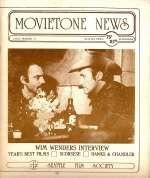


 [Originally published in Movietone News 54, June 1977]
 [Originally published in Movietone News 60-61, February 1979]