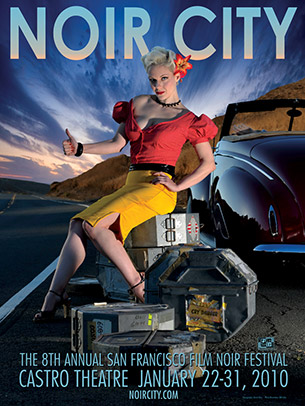
The Film Noir Foundation, creators of the San Francisco-based Noir City Film Festival and its companion travelling version, expanded its purpose a few years ago to raise money to restore orphaned films, those independent productions made outside the studio system in partnerships formed in some cases to make a single film. Two of their most recent restorations have come to disc in lovely sets: the superb Woman on the Run (Flicker Alley, Blu-ray+DVD) with Ann Sheridan and the fascinating Too Late for Tears (Flicker Alley, Blu-ray+DVD) with Lizabeth Scott.
 In Too Late for Tears (1949), Lizabeth Scott plays one of the most ruthless heroines in film noir in, a status-conscious middle-class wife who will do anything to keep her hands on a suitcase of cash that lands in her lap by accident. Arthur Kennedy is her husband who wants to take it to the police but is tempted enough to hold onto it for a night or two (just to think over the ramifications, you know) and Dan Duryea is a mercenary crook who comes looking for the cash (payment in a blackmail scheme) and ends up her wary partner. Scott has played her share of heroines and villains both but here she’s pure avarice and cold-blooded greed. She stares at the money piled on the bed with wolfish hunger and childish ecstasy and she’s ready to murder to keep it. The money doesn’t corrupt her, it merely unleashes her suppressed greed. She’s nervous and perhaps even reluctant to carry out the first—fate steps in with a nudge when she hesitates—but she follows through without a regret and doesn’t even flinch the second time. Scott may be a poor man’s Bacall but is no man’s fool. Duryea is in fine form as a weasel of an opportunist, sneering his dialogue in the early scenes and then slipping into disgust and drink as Scott slowly takes control of the partnership. In a genre defined by corrupt, ruthless, and conniving characters, this film features two of the most reprehensible and cold-blooded. Don DeFore is the old “army buddy” who hides his own secrets.
Read More “Blu-ray: ‘Woman on the Run’ and ‘Too Late for Tears’ restored”
 Noir City 2013, my favorite Seattle festival of the year, opens for a week of double-feature showings (and one triple-feature) of classics, rarities, rediscoveries, and restorations. I preview the opening night program of two Cy Enfield pictures, the independently-made Try and Get Me! (1950), rescued and restored thanks to the efforts of the Film Noir Foundation, and The Hell Drivers (1957),
 Returning to Seattle screens is The Window (1949), the “boy who cried wolf” noir and the first film restored by the Film Noir Foundation (festival founder and ever-present host Eddie Muller brought it to SIFF years before he brought Noir City to Seattle) and The Chase (1946), a Cornell Woolrich adaptation that played in SIFF’s archival line-up just last year. The former creates a marvelous atmosphere of a sweltering New York summer in the city in the oppressive urban clutter of tenements and apartment houses where a bored young kid sees a murder committed across the alley, and the latter puts a surreal twist to classic noir elements in the story of a shell-shocked veteran (Robert Cummings) who gets tangled up with a Miami mobster and his desperate wife and slips into a nightmarish B-movie exaggeration of the nocturnal criminal world.
 In a timely bit of programming synchronicity, Northwest Film Festival presents a revival of Michael Roemer’s Nothing But a Man (1964), a drama of African-American working class life in sixties America. The synchronicity? On Monday, February 25, Noir City offers a pair of films with African-American protagonists: the above-mentioned Native Son and the 1949 Intruder in the Dust.