


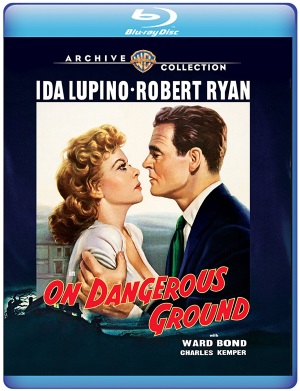
 On Dangerous Ground (Warner Archive, Blu-ray) (1952), directed by Nicholas Ray from a script he developed with A.I. Bezzerides and producer John Houseman, opens on the urgent yet fractured dramatic score by Bernard Herrmann, a theme that rushes forward anxiously, pauses with quieter instruments, then jumps again as we watch the nocturnal city streets in the rain through the windshield of a moving car. This is the view of the city as seen by Jim Wilson (Robert Ryan), as an obsessive, tightly-wound police detective who works the night shift on the urban streets of an unnamed city filled with grifters, hookers, and petty crooks. He’s as dedicated as they come—he studies mug shots over his meal before the start of shift—but he has no family, no girl, no hobbies, as a quick survey of his Spartan apartment shows, and his single-minded focus on the job has twisted the compassion out of him. When his anger boils over into violence once too often, he’s sent out of town to help with a murder case in the rural countryside.
Read More “#Noirvember Blu-ray: The rural noir of ‘On Dangerous Ground’ and ‘Road House’”

 Johnny Guitar: Olive Signature (Olive, Blu-ray, DVD) – Joan Crawford’s Vienna is the most masculine of women western heroes. A former saloon girl who earned her way to owning her own gambling house, she’s a mature woman with a history and she’s not ashamed of what she did to carve out her claim for a future.

 The American Friend (Criterion, Blu-ray, DVD) – “What’s wrong with a cowboy in Hamburg?” Dennis Hopper’s Tom Ripley is nothing like the character that Patricia Highsmith created and explored in five novels, and while Wim Wenders’s adaptation of Ripley’s Game, the sequel to The Talented Mr. Ripley, remains more or less faithful to the plot (with additional elements appropriated from Ripley Underground), the personality and sensibility belong to Wenders.
 James Dean Ultimate Collector’s Edition (Warner, Blu-ray)


 Nicholas Ray was one of the most interesting directors in Hollywood in the 1950s. He was fascinated by outcasts and orphans, father figures and struggling sons, broken people driven by anger and colliding with society, anxious teenagers and young adults looking for their identity and their place in a hostile world. By any measure, Run For Cover is second-tier Ray, a western with interesting colors in a familiar frame. Made between his cult western Johnny Guitar and his legendary Rebel Without a Cause, it in many ways anticipates the latter in the western mode of the former, though with a more conventional approach and an emphasis on the father figure over the symbolic son.

 [Originally published in Movietone News 57, February 1978]


 [Originally published in Movietone News 60-61, February 1979]

