

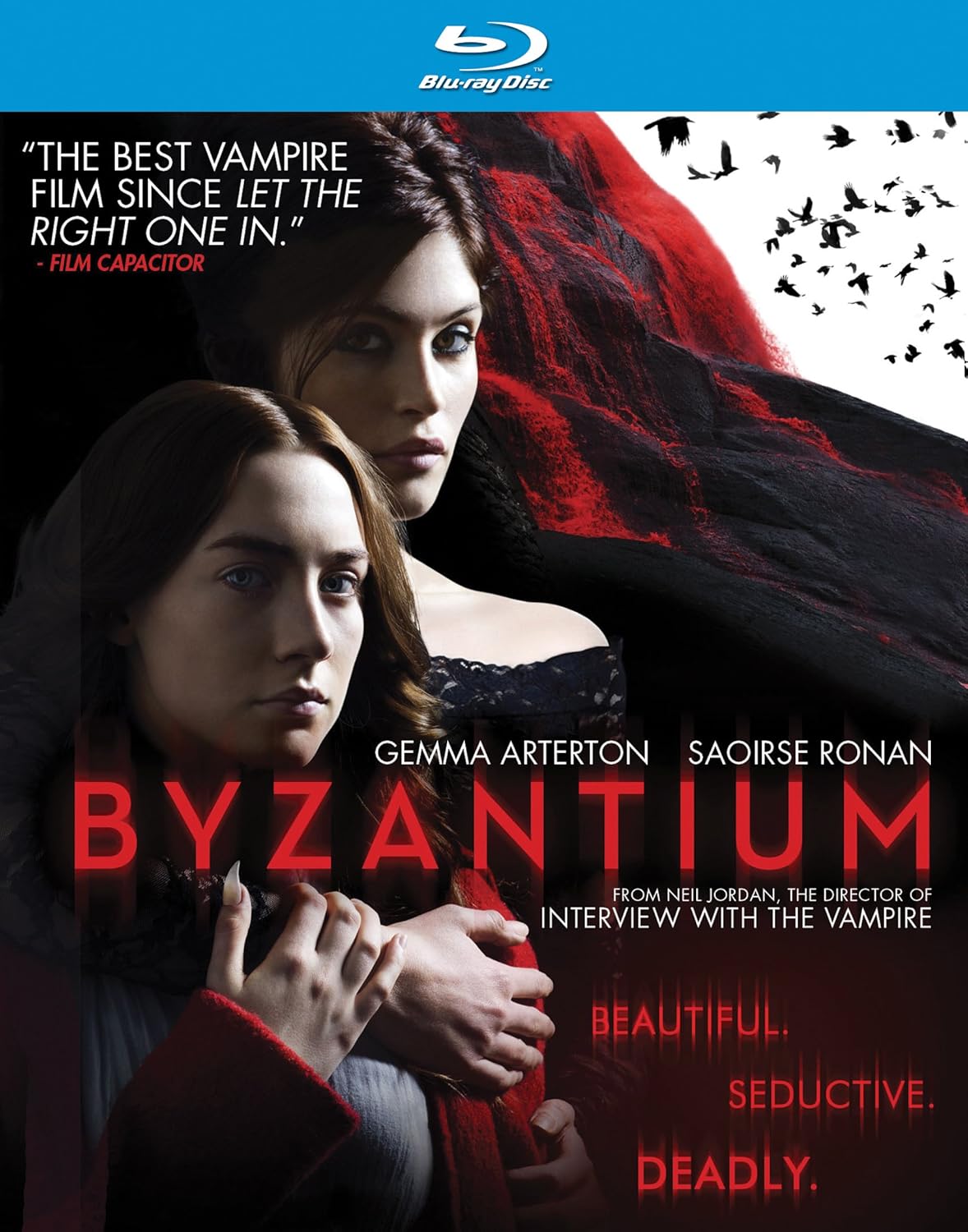
 Neil Jordan has long been captivated by the meeting of myth and magic and storytelling with the material world of love and sex and family, from the fairytale reworking of A Company of Wolves through the folktale on the Irish coast in Ondine. Byzantium, based on a play by Moira Buffin, is his second take on the vampire legend and this one is far less traditional than Interview with a Vampire. There is blood, of course, and there is sex, but it’s less about eros than survival as an eternal in a mortal world, and as woman who dares claim the rights reserved by a cabal of men.
Clara (Gemma Arterton) walks the streets (in this case, the boardwalk of a British coastal town in the off-season) to pay the bills for herself and Eleanor (Saoirse Ronan), an eternal sensitive teen pouring out her soul in unread letters cast to the wind. Flashbacks tell their origins: a life of degradation at the hands of a British officer (a proudly debauched Jonny Lee Miller) in an 18th century culture of male power and class division, and a desperate attempt to escape a death sentence of disease through an ancient ritual reserved for a cabal of powerful men who ruthlessly guard the secret of immortality.
Byzantium is rich with metaphor and sexual politics, almost overwhelmingly so. It’s a Gothic tale with a twist of conspiracy and a radically different take on vampirism as ancient earth force tightly controlled by a male cabal who treat the transformation like a birthright.


 The blood-dimmed tide is loosed in Neil Jordan’s second coming to the vampire myth, Byzantium. Even seen solely as a vampire film Byzantium far surpasses Jordan’s 1994 Interview with the Vampire—and pretty much everything else in the genre. But while Jordan’s and scenarist Moira Buffini’s expansion of Buffini’s stage play A Vampire Story can be enjoyed as a straightforward—albeit narratively complex—vampire tale, it is much more. The familiar tropes of vampire lore (to which Irish folklore has contributed at least as much as middle-European) become, under Jordan’s skilled hand and eye, haunting visual metaphors for the tyranny of the body, the marginalization of the outsider, the economic suppression of Ireland, the subjection of women, and, most importantly, the means of rebellion against all of these. Vampires and whores, predators and victims—how can we tell the dancer from the dance?