In 2017, the Marvel comic book conglomerate took a wackadoodle turn that coughed up two of its most fluid, playful movies yet: the sprightly Spider-Man: Homecoming and the irreverent Thor: Ragnarok. Those films suggested how frisky space might be carved out within the crushing sameness of the superhero formula and the larger universe-building of Marvel’s mega-plotline. And they did it largely with humor. In that sense, Black Panther is something of a course correction. Burdened with establishing a superhero whose distinguishing characteristics are dignity and his royal duties to his people (whatever his problems, Hulk never had to send a balanced-budget bill to congress) and world-building an entire African civilization, Black Panther can’t spend much time on fripperies. This is serious superhero business.
That gravity is the movie’s strength and weakness.
The Hobbit: The Battle of the Five Armies (Warner, Blu-ray, Blu-ray 3D, DVD, VOD), the third and final installment of Peter Jackson’s supersized take on J.R.R. Tolkien’s fantasy, opens with a spectacular dragon attack on Laketown and tops it with a battle that nearly dwarfs the Middle Earth-shattering war Lord of the Rings trilogy (pun intended). It’s Elf and Man against Dwarf, but for the Orcs it’s personal. Which, as any fan of the original novel “The Hobbit” will tell you, pretty much misses the point of the story. But then Jackson isn’t interested in a faithful interpretation of Tolkien’s novel as much as backfilling a prequel story to The Lord of the Rings, transforming the novel’s story of legacy and destiny warped into greed and hubris, a grand fantasy adventure with dragons and trolls and Shakespearean dimensions, into the initial stirrings of the evil Sauron and a war that will engulf the world and all the races.
That pretty much sidelines Bilbo Baggins (Martin Freeman), the ostensible hero of the tale, while redirecting the focus to characters who never appeared in the original novel or in Tolkien’s universe at all, namely the above-mentioned Orcs with a grudge against Thorin (Richard Armitage), the Dwarf who would be king. The final half of the film, which is already the third film in the telling, is an enormous battle and, yes, it is impressive as a physical thing. It’s also exhausting and overdone, with two Orc villains who prove comically unkillable. These guys are fiercer than the next generation Orc-Goblin hybrids that Sauroman breeds in Lord of the Rings.
Martin Freeman as Bilbo, John Callen as support dwarf
As holiday movie titles go, The Desolation of Smaug is a less-than-catchy handle for an evening’s buoyant entertainment. But only to the uninitiated. To the throbbing fan base of The Hobbit, J.R.R. Tolkien’s fun and relatively compact fantasy novel, those words portend sheer fire-breathing awesomeness.
By now you know that The Hobbit has been elongated into three hefty movies by Lord of the Rings director Peter Jackson. Smaug is the middle one, and it improves on last year’s rambling An Unexpected Journey by sticking to a clean, headlong storyline and jettisoning much of Part 1’s juvenile humor. Our hero, Bilbo Baggins (Martin Freeman), is traveling with his crowd of bumptious dwarfs, intent on finding a magical stone inside a mountain crammed with treasure. Wee wrinkle: The mountain is home to a dragon named Smaug (voiced by Benedict Cumberbatch), who likes to emerge periodically from his lair and burn down neighboring Laketown.
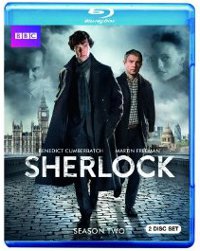
It sounded like a terrible idea at the time: update Sherlock Holmes to the 21st century of texts and computer searches and blogs.
To the surprise and delight of all, the first series of Sherlock, the BBC revival / revision of the classic detective developed by Steven Moffat and Mark Gatiss was intelligent, inspired, clever, compelling, and very, very entertaining. Sherlock: Season Two (BBC), which consists of three feature-length mysteries, ups the ante and the ambition.
Benedict Cumberbatch’s Sherlock is still a tetchy, borderline Asperger syndrome genius more interested in a challenge than justice and Martin Freeman’s Watson holds his own as a witty, warm, loyal and often critical assistant to his eccentric roommate. But in this run the anti-social Holmes has become a media celebrity and Jim Moriarty not merely an underworld mastermind but an insane criminal who, like Holmes, just wants a challenge.
The creators don’t just update the classic stories, they reimagine them. The inspirations are imbedded in the tweaked titles — “An Affair in Belgravia” (with Lara Pulver as a memorable Irene Adler), “The Hounds of Baskerville” (set in Britain’s answer to Area 51), and “The Reichenbach Fall” (with Andrew Scott as insane criminal genius James Moriarty) — and writers Moffat and Gatiss (who serves double duty as Sherlock’s brother Mycroft onscreen) spin new stories out of the situations and characters and iconic elements of the originals
The three episodes are really feature films, not just in running time but in scope and depth and complexity, and director Paul McGuigan adds a visual aesthetic to match in the first two films of the second season. We don’t simply observe the way Sherlock cases a room, we get a peek into the way he picks out details and files away observations, and an idea at the restlessness of his OCD mind.
Benedict Cumberbatch and Martin Freeman
But it wouldn’t work without the characters, the fully-realized characterizations, and the chemistry. As played by Cumberbatch, Holmes is a magnificent character and this is the first incarnation to allow him to be such a thoughtless misanthrope (even while showing the cracks in his emotional armor). But let us please acknowledge that Freeman’s far less showy yet equally realized John Watson is the best screen incarnation of this character ever, an intelligent, capable military doctor with as much courage as compassion. And the makeover of Lestrade from the bumbling foil and comic relief of previous adaptations into a competent, talented police detective with both professional and personal interests in Sherlock only adds to dynamic. It’s always more interesting when Sherlock is the smartest person in a room full of smart people.
Contains information related to marketing campaigns of the user. These are shared with Google AdWords / Google Ads when the Google Ads and Google Analytics accounts are linked together.
90 days
__utma
ID used to identify users and sessions
2 years after last activity
__utmt
Used to monitor number of Google Analytics server requests
10 minutes
__utmb
Used to distinguish new sessions and visits. This cookie is set when the GA.js javascript library is loaded and there is no existing __utmb cookie. The cookie is updated every time data is sent to the Google Analytics server.
30 minutes after last activity
__utmc
Used only with old Urchin versions of Google Analytics and not with GA.js. Was used to distinguish between new sessions and visits at the end of a session.
End of session (browser)
__utmz
Contains information about the traffic source or campaign that directed user to the website. The cookie is set when the GA.js javascript is loaded and updated when data is sent to the Google Anaytics server
6 months after last activity
__utmv
Contains custom information set by the web developer via the _setCustomVar method in Google Analytics. This cookie is updated every time new data is sent to the Google Analytics server.
2 years after last activity
__utmx
Used to determine whether a user is included in an A / B or Multivariate test.
18 months
_ga
ID used to identify users
2 years
_gali
Used by Google Analytics to determine which links on a page are being clicked
30 seconds
_ga_
ID used to identify users
2 years
_gid
ID used to identify users for 24 hours after last activity
24 hours
_gat
Used to monitor number of Google Analytics server requests when using Google Tag Manager
1 minute
Marketing cookies are used to follow visitors to websites. The intention is to show ads that are relevant and engaging to the individual user.
A video-sharing platform for users to upload, view, and share videos across various genres and topics.
Registers a unique ID on mobile devices to enable tracking based on geographical GPS location.
1 day
VISITOR_INFO1_LIVE
Tries to estimate the users' bandwidth on pages with integrated YouTube videos. Also used for marketing
179 days
PREF
This cookie stores your preferences and other information, in particular preferred language, how many search results you wish to be shown on your page, and whether or not you wish to have Google’s SafeSearch filter turned on.
10 years from set/ update
YSC
Registers a unique ID to keep statistics of what videos from YouTube the user has seen.
Session
DEVICE_INFO
Used to detect if the visitor has accepted the marketing category in the cookie banner. This cookie is necessary for GDPR-compliance of the website.
179 days
LOGIN_INFO
This cookie is used to play YouTube videos embedded on the website.


 The Hobbit: The Battle of the Five Armies (Warner, Blu-ray, Blu-ray 3D, DVD, VOD), the third and final installment of Peter Jackson’s supersized take on J.R.R. Tolkien’s fantasy, opens with a spectacular dragon attack on Laketown and tops it with a battle that nearly dwarfs the Middle Earth-shattering war Lord of the Rings trilogy (pun intended). It’s Elf and Man against Dwarf, but for the Orcs it’s personal. Which, as any fan of the original novel “The Hobbit” will tell you, pretty much misses the point of the story. But then Jackson isn’t interested in a faithful interpretation of Tolkien’s novel as much as backfilling a prequel story to The Lord of the Rings, transforming the novel’s story of legacy and destiny warped into greed and hubris, a grand fantasy adventure with dragons and trolls and Shakespearean dimensions, into the initial stirrings of the evil Sauron and a war that will engulf the world and all the races.

 It sounded like a terrible idea at the time: update Sherlock Holmes to the 21st century of texts and computer searches and blogs.
