[Originally published in Movietone News 26, October 1973]
When challenged that the American and rightwing villains in his State of Siege were too thoroughly villainous and the leftwing revolutionaries too absurdly decent and clean-cut, Costa-Gavras disingenuously replied that he saw nothing terribly wrong in that: why shouldn’t the Left indulge itself with black-and-white entertainments when the Right had been doing so for years? Sacco and Vanzetti can cop the same plea, but it has plenty more to recommend it. John Simon named the film on his 1971 Ten Best List because, he maintained, it dramatically brought to light a reprehensible miscarriage of justice callously perpetrated by officials of the government which ought never be forgotten.
[Originally published in Movietone News 28, December 1973]
The Mattei Affair affords one of the year’s most peculiar film experiences. I think most people who see it will agree with that, whether or not their personal reactions to the picture closely resemble my own (possibly very subjective) response. For about half the film’s running time I was conscious of enduring the movie more than experiencing it. It offers few of the conventional compensations. For one thing, its subject is highly political—and not only political but also, as it appears for a while, narrowly regional. Who is—was—Enrico Mattei? An official in an Italian state industry who concerned himself with realizing the oil and especially the methane resources of various impoverished sectors of the country, and who died in the mysterious crash of his private jet in 1962. The movie opens, Citizen Kane–like, with Mattei’s death, presented fragmentarily through the points of view of a farmer who’s awakened by the crash, the airline personnel routinely monitoring the flight, and various media contingents who leap into action to cover the event. Immediately the case is fragmented even further: there is a flashback from the discovery and aftermath of the crash to the crash actually occurring; and then time and place and point-of-view become still more problematical. A bank of TV screens gives back diverse images of Mattei at various stages of his career, images of newsmen commenting on Mattei, images of other people being interviewed about Mattei—and some of the screens are just full of static; more or loss constantly, at least one of them glows with the words ENRICO MATTEI, as though The Truth were lurking, “Rosebud”-like, ExecutiveAction–like, amid this welter of available media documentation.
My films tell a little bit of the history of Italy.
—Carlo Lizzani
More than a decade before the French New Wave, a generation of Italian film critics and cinephiles challenged the high gloss and low ambitions of the Italian film industry under Mussolini with a wave of films that addressed social and political life during and after World War II, movies shot in the streets with a rough immediacy dictated as much by threadbare production resources as by stylistic choice.
Carlo Lizzani was not simply shaped by Italian neorealism. He helped create it. As a film critic and an active leftist, he wrote manifestos promoting neorealism and wrote a respected history of Italian cinema in 1952. He co-wrote and assisted on the productions of Roberto Rossellini‘s Germany Year Zero (1948), Giuseppe De Santis’ Bitter Rice (1949), which earned him an Academy Award nomination and Alberto Lattuada‘s The Mill on the Po(1949). He made documentaries before making his feature directing debut with the resistance drama Attention! Bandits! (1951), a film he got made by organizing the workers of Genoa into a filmmaking cooperative, and he returned to documentaries at the end of his career, making films about the great Italian directors he knew and admired: Luchino Visconti, Roberto Rossellini, Giuseppe De Santis. His love of cinema and his passion for politics and history came together in his 1996 feature Celluloid, which dramatizes the making of the pioneering neorealist masterpiece Rome Open City.
Between these poles, Lizzano had a thriving career making genre films—westerns, crime thrillers, war dramas—in the 1960s and 1970s. It was more than simply a matter of necessity. He loved genre pictures. They were also a superb vehicle for smuggling political commentary into popular cinema. It was a good fit for a filmmaker with an affinity for rebels and outlaws.
[Originally published in Movietone News 36, October 1974]
Francesco Rosi’s attempt to adapt the method of TheMattei Affair to the career of Charles “Lucky” Luciano fails almost completely. What made the earlier film such a morally disturbing and aesthetically challenging experience was its formal complexity as a real-life mystery story in which the levels and processes of the narrative act became implicated in the hypotheses and half-truths it hoped to sort out. No such structural complexity informs LuckyLuciano. Sections of the movie are compelling, partly because they are imaginatively filmed, partly—the greater part—because they provide us with fascinating historical dirt: e.g., the connivance between Vito Genovese (Charles Cioffi) and the United States Army after the liberation of Italy. But whereas the fractured chronology and mixture of narrative modes served in MatteiAffair to render the very abundance of its mountain of evidence meaningful, here the method merely produces a muddle.
The spaghetti western was not an inherently political genre but in the 600+ Italo-Westerns that poured out in the decade or so of its brief reign, among the shamelessly derivative pictures cranked out to cash in on the boom started by Sergio Leone’s international hit A Fistful of Dollars are a handful that draw upon the currents of contemporary Italian and European cinema.
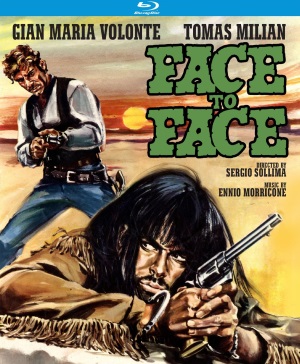
Sergio Sollima only directed three westerns but he brought political and allegorical elements to the familiar conventions.Face to Face (Kino Lorber Studio Classics, Blu-ray, DVD), his second western, is his most interesting. It is also one of the least known, having never received a legitimate American home video release in any format until now.
There are no imported Americans in this film. Gian Maria Volonté (the head villain in A Fistful of Dollars) takes the lead as Professor Brett Fletcher, a history teacher and intellectual who takes leave from his Eastern college (though only seen in interiors, it looks more European than American) and travels west for his health. Cuban-born Tomas Milian (who also starred in Sollima’s The Big Gundown) is the Mexican bandit Solomon ‘Beauregard’ Bennet, who enters the film in shackles. Fletcher’s kindness to the prisoner gives Bennet an opportunity to take him hostage and escape, but that same kindness leads to a tenuous truce that turns into friendship and later partnership.
Contains information related to marketing campaigns of the user. These are shared with Google AdWords / Google Ads when the Google Ads and Google Analytics accounts are linked together.
90 days
__utma
ID used to identify users and sessions
2 years after last activity
__utmt
Used to monitor number of Google Analytics server requests
10 minutes
__utmb
Used to distinguish new sessions and visits. This cookie is set when the GA.js javascript library is loaded and there is no existing __utmb cookie. The cookie is updated every time data is sent to the Google Analytics server.
30 minutes after last activity
__utmc
Used only with old Urchin versions of Google Analytics and not with GA.js. Was used to distinguish between new sessions and visits at the end of a session.
End of session (browser)
__utmz
Contains information about the traffic source or campaign that directed user to the website. The cookie is set when the GA.js javascript is loaded and updated when data is sent to the Google Anaytics server
6 months after last activity
__utmv
Contains custom information set by the web developer via the _setCustomVar method in Google Analytics. This cookie is updated every time new data is sent to the Google Analytics server.
2 years after last activity
__utmx
Used to determine whether a user is included in an A / B or Multivariate test.
18 months
_ga
ID used to identify users
2 years
_gali
Used by Google Analytics to determine which links on a page are being clicked
30 seconds
_ga_
ID used to identify users
2 years
_gid
ID used to identify users for 24 hours after last activity
24 hours
_gat
Used to monitor number of Google Analytics server requests when using Google Tag Manager
1 minute
Marketing cookies are used to follow visitors to websites. The intention is to show ads that are relevant and engaging to the individual user.
A video-sharing platform for users to upload, view, and share videos across various genres and topics.
Registers a unique ID on mobile devices to enable tracking based on geographical GPS location.
1 day
VISITOR_INFO1_LIVE
Tries to estimate the users' bandwidth on pages with integrated YouTube videos. Also used for marketing
179 days
PREF
This cookie stores your preferences and other information, in particular preferred language, how many search results you wish to be shown on your page, and whether or not you wish to have Google’s SafeSearch filter turned on.
10 years from set/ update
YSC
Registers a unique ID to keep statistics of what videos from YouTube the user has seen.
Session
DEVICE_INFO
Used to detect if the visitor has accepted the marketing category in the cookie banner. This cookie is necessary for GDPR-compliance of the website.
179 days
LOGIN_INFO
This cookie is used to play YouTube videos embedded on the website.


 [Originally published in Movietone News 26, October 1973]


 [Originally published in Movietone News 36, October 1974]
 The spaghetti western was not an inherently political genre but in the 600+ Italo-Westerns that poured out in the decade or so of its brief reign, among the shamelessly derivative pictures cranked out to cash in on the boom started by Sergio Leone’s international hit A Fistful of Dollars are a handful that draw upon the currents of contemporary Italian and European cinema.