Is Mildred Pierce (1945) (Criterion, Blu-ray, DVD) film noir or melodrama? I say why choose? Film noir is almost entirely associated with crime stories and life in the shadows and at night in the city and sure enough Mildred Pierce, based on the novel by James M. Cain, opens with death and darkness and the twilight of the soul. But there’s a subset of noir rooted in melodrama or the women’s pictures, as they were called in the 1940s and 1950s, films about the lives of women as they reach for their American dream, or at least the one promised them in love, marriage, and family. Mildred Pierce offers both, almost as two separate films that converge in the final act

It opens squarely in film noir territory (not that there is anything square and simple in noir), with a point blank murder and grotesque dying convulsions of a man who, even at first glance, convinces us he’s an oily, unclean manipulator who surely earned his terrible death. It’s Zachary Scott in a lounge lizard mustache playing his trademark gigolo with weasely insincerity—almost too perfect for our opening victim. We’ll get back to the corpse but first we leave the beach house scene of the crime for a seedy part of the boardwalk and a woman in fur (Joan Crawford) gripping the rail with every indication of a suicidal plunge into the surf. There’s a gaudily colorful bar with a Polynesian theme owned by Jack Carson, appropriately attired in a white tux that screams new money and no taste especially next to the elegance of Crawford, a nightcap, and what appears to be a neat little frame for murder that sweeps all of our characters into the police station for questioning.
You don’t think of Michael Curtiz, the great house director of Warner Bros. spectacles and prestige pictures, as one of the great noir directors but the opening twenty minutes or so is a master class in film noir directing, in part thanks to stunning nocturnal images by cinematography Ernest Haller (his work earned an Oscar nomination, one of six that the film racked up).


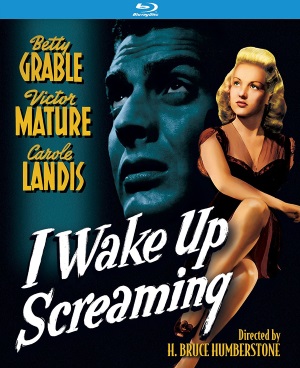 I Wake Up Screaming (Kino Lorber Studio Classics, Blu-ray) is not just one of the great movie titles of classic cinema, it is one of the films that established the distinctive style and attitude of film noir, from the blast of a headline shouting BEAUTIFUL MODEL FOUND MURDERED to the third degree given to swaggering sports promoter Frankie Christopher (Victor Mature) under the glare of a blinding lamp in a rather suspicious room of worn brick and cast-off furnishings, more of a cell than an official interrogation room. Mature is lit up in the center of the screen while hard shadows assault the walls and slashes of light and looming silhouettes give the cordon of cops wrapped around him a look more like intimidating mob hoods than New York’s finest. On the other side of the dungeon door is the public side of the detective’s room where Jill Lynn (Betty Grable), the victim’s sister, is treated more gently, but she’s just as trapped. When the camera swings around we see a cage around her. The picture opens with a punch and the backstory is quickly filled in with jabs of flashbacks, jumping back and forth between the smart mouthed dandy of a promotor and the demure young woman as they lay out the events leading up to the murder of ambitious Carole Landis, the hash slinger promoted to celebrity success by Mature like a noir Pygmalion.

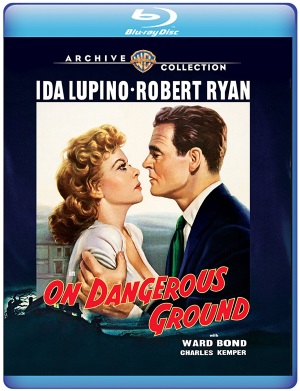 On Dangerous Ground (Warner Archive, Blu-ray) (1952), directed by Nicholas Ray from a script he developed with A.I. Bezzerides and producer John Houseman, opens on the urgent yet fractured dramatic score by Bernard Herrmann, a theme that rushes forward anxiously, pauses with quieter instruments, then jumps again as we watch the nocturnal city streets in the rain through the windshield of a moving car. This is the view of the city as seen by Jim Wilson (Robert Ryan), as an obsessive, tightly-wound police detective who works the night shift on the urban streets of an unnamed city filled with grifters, hookers, and petty crooks. He’s as dedicated as they come—he studies mug shots over his meal before the start of shift—but he has no family, no girl, no hobbies, as a quick survey of his Spartan apartment shows, and his single-minded focus on the job has twisted the compassion out of him. When his anger boils over into violence once too often, he’s sent out of town to help with a murder case in the rural countryside.
 In Too Late for Tears (1949), Lizabeth Scott plays one of the most ruthless heroines in film noir in, a status-conscious middle-class wife who will do anything to keep her hands on a suitcase of cash that lands in her lap by accident. Arthur Kennedy is her husband who wants to take it to the police but is tempted enough to hold onto it for a night or two (just to think over the ramifications, you know) and Dan Duryea is a mercenary crook who comes looking for the cash (payment in a blackmail scheme) and ends up her wary partner. Scott has played her share of heroines and villains both but here she’s pure avarice and cold-blooded greed. She stares at the money piled on the bed with wolfish hunger and childish ecstasy and she’s ready to murder to keep it. The money doesn’t corrupt her, it merely unleashes her suppressed greed. She’s nervous and perhaps even reluctant to carry out the first—fate steps in with a nudge when she hesitates—but she follows through without a regret and doesn’t even flinch the second time. Scott may be a poor man’s Bacall but is no man’s fool. Duryea is in fine form as a weasel of an opportunist, sneering his dialogue in the early scenes and then slipping into disgust and drink as Scott slowly takes control of the partnership. In a genre defined by corrupt, ruthless, and conniving characters, this film features two of the most reprehensible and cold-blooded. Don DeFore is the old “army buddy” who hides his own secrets.