[Originally published in Movietone News 33, July 1974]
Art, because it creates its own reality, can’t be self-deluding, no matter how “unreal” it may seem. What it can do is distort reality by rearranging life’s subject matter into new and unfamiliar forms. Thus, in Badlands, Terrence Malick’s first directorial project, Kit Carruthers’ personal fantasy is distinct from Malick’s artistic fantasy, although the two run closely parallel and indeed often seem inseparable. Kit (played by Martin Sheen) insulates himself within the brash shield of a James Dean tough-guy image to the point where, by the end of the movie, all he is concerned with is going out in style. Reality, for Kit, ultimately becomes irrelevant, just as, in a similar sense, our normal conceptions of what goes on in the world apply less and less to what we are seeing on the screen as the movie progresses.
Zero Dark Thirty (Sony) has been praised as the best American film of 2012. It’s also been accused of justifying American torture of detainees and turned into a political football by members of congress demanding an investigation into the intelligence provided to the filmmakers by the administration.
That’s testament to the complexity of the film and the volatile nature of the subject matter. The direction by Kathryn Bigelow, who won Oscars for Best Film and Best Director in her previous film “The Hurt Locker,” is fierce and focused and Mark Boal’s screenplay grapples with the messy history of the eight-year-long intelligence operation to find Osama Bin Laden by refusing to make a spy thriller out of it.
As in The Hurt Locker, Zero Dark Thirty shows us what this kind war does to the soldiers in the field, in particular Jessica Chastain’s Maya, a fictionalized take on the real CIA agent who unrelentingly followed the slimmest of leads and synthesized seemingly unrelated pieces of information into a map that led to Bin Laden. But the focus is not on the personal sacrifice so much as on the enormity of the job and the tenacity of one agent (“Washington says she’s a killer,” is the one-sentence resume offered on her arrival) to doggedly follow the trail while the bureaucrats and politicians weigh resources and shift focus with each new threat. After the tension and anxiety builds through the investigation, Bigelow pays off with the raid on the compound, played out in real time without movie heroics.
This isn’t documentary, mind you, and Bigelow and Boal take some dramatic license in the details, but it’s in the service of exploring the real story of the investigation as well as the culture of intelligence work and the reality of agents in the field battling bureaucracy on the one hand and terrorists on their own home field on the other. It is intelligent, uncompromising, and utterly compelling, and it begins right off by showing the torture and waterboarding of a prisoner, a man that the lead interrogator (Jason Clarke) admits right off will never be released.
That’s the reality of the war on terror in 2003 and priority #1 is finding and capturing Bin Laden. By refusing to duck the role of torture, and even more daringly refusing to have Maya verbally condemn it, Bigelow drew some heat. While the government vainly tried to claim it somehow distorted American policy (when in fact the policy itself was distorted), others have charged that the film makes the case that torture was a successful tool, when in fact Bigelow and Boal show us that it never produced any information that wasn’t already gathered through other means, and failed to produce reliable intelligence on pressing threats.
Bigelow leaves it to us to draw our own conclusions — on the morality of torture as well as the effectiveness of it — and it appears to have become a Rorschach test for audiences. The controversy fueled interest in the film but it may have cost Bigelow an Oscar nomination for her direction, which by my measure is the most accomplished and the most gripping American film of 2012.
It was nominated for five Academy Awards, including Best Picture, Best Actress (Chastain), and Best Original Screenplay, and won for Best Sound Editing (shared with Skyfall), and it was the number one choice on MSN’s critics’ poll.
The Blu-ray and DVD both present four featurettes, all under ten minutes. “The Compound” is the longest of them and it is indeed a guided tour of the set built to serve as the Bin Laden compound. “Geared Up” looks at the equipment used by the actors playing SEAL Team Six and the training they went through for the invasion scene and “Targeting Jessica Chastain” is a brief profile of the Chastain and the character of Maya. Though brief, they offer a lot of detail on the preparation and research behind the production. The least of the supplements, in fact, is “No Small Feat,” which purports to be the “making of” production but is actually a four-minute promotional piece. The Blu-ray also features an UltraViolet digital copy for download and instant streaming.
The Life and Death of Colonel Blimp (Criterion), an unconventional wartime drama from The Archers (director Michael Powell and screenwriter Emeric Pressburger), was made against the wishes of the British government and went on to become one of the most beloved British films of all time.
This dashing, deft epic begins with the dinosaur of an old soldier, Major General Clive Wynne-Candy (a curmudgeonly Roger Livesay in a bald cap and walrus mustache), getting ambushed by the new young army in an attempt to jolt the old man out of his outdated notions of a “gentleman’s war” against the Nazis, and then drifts back to show just how Candy got here. Livesay is warm and witty as an ambitious young officer with a prankster’s streak, who becomes devoted to his German rival (Anton Walbrook) and falls in love with a series of beautiful women (all of them played by Deborah Kerr), all the while petrifying as the world changes around him over the course of three wars.
Contains information related to marketing campaigns of the user. These are shared with Google AdWords / Google Ads when the Google Ads and Google Analytics accounts are linked together.
90 days
__utma
ID used to identify users and sessions
2 years after last activity
__utmt
Used to monitor number of Google Analytics server requests
10 minutes
__utmb
Used to distinguish new sessions and visits. This cookie is set when the GA.js javascript library is loaded and there is no existing __utmb cookie. The cookie is updated every time data is sent to the Google Analytics server.
30 minutes after last activity
__utmc
Used only with old Urchin versions of Google Analytics and not with GA.js. Was used to distinguish between new sessions and visits at the end of a session.
End of session (browser)
__utmz
Contains information about the traffic source or campaign that directed user to the website. The cookie is set when the GA.js javascript is loaded and updated when data is sent to the Google Anaytics server
6 months after last activity
__utmv
Contains custom information set by the web developer via the _setCustomVar method in Google Analytics. This cookie is updated every time new data is sent to the Google Analytics server.
2 years after last activity
__utmx
Used to determine whether a user is included in an A / B or Multivariate test.
18 months
_ga
ID used to identify users
2 years
_gali
Used by Google Analytics to determine which links on a page are being clicked
30 seconds
_ga_
ID used to identify users
2 years
_gid
ID used to identify users for 24 hours after last activity
24 hours
_gat
Used to monitor number of Google Analytics server requests when using Google Tag Manager
1 minute
Marketing cookies are used to follow visitors to websites. The intention is to show ads that are relevant and engaging to the individual user.
A video-sharing platform for users to upload, view, and share videos across various genres and topics.
Registers a unique ID on mobile devices to enable tracking based on geographical GPS location.
1 day
VISITOR_INFO1_LIVE
Tries to estimate the users' bandwidth on pages with integrated YouTube videos. Also used for marketing
179 days
PREF
This cookie stores your preferences and other information, in particular preferred language, how many search results you wish to be shown on your page, and whether or not you wish to have Google’s SafeSearch filter turned on.
10 years from set/ update
YSC
Registers a unique ID to keep statistics of what videos from YouTube the user has seen.
Session
DEVICE_INFO
Used to detect if the visitor has accepted the marketing category in the cookie banner. This cookie is necessary for GDPR-compliance of the website.
179 days
LOGIN_INFO
This cookie is used to play YouTube videos embedded on the website.


 [Originally published in Movietone News 33, July 1974]
 Zero Dark Thirty (Sony) has been praised as the best American film of 2012. It’s also been accused of justifying American torture of detainees and turned into a political football by members of congress demanding an investigation into the intelligence provided to the filmmakers by the administration.
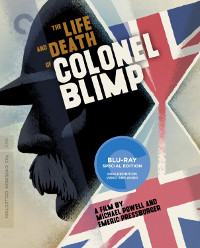 The Life and Death of Colonel Blimp (Criterion), an unconventional wartime drama from The Archers (director Michael Powell and screenwriter Emeric Pressburger), was made against the wishes of the British government and went on to become one of the most beloved British films of all time.