


“I don’t interpret. I don’t transmit any message. I avoid expressing theories and forcing meanings. I reconstruct documents, I offer information which leaves to the spectator the entire responsibility for his own judgments.”
– Roberto Rossellini
 This week, Criterion resurrects key productions from Roberto Rossellini’s cycle of historical films directed for television in the final act of his career. Largely overlooked in light of his legendary neorealist dramas and his more intimate dramas starring his lover Ingrid Bergman, these films are could technically be considered historical dramas, but they are nothing like the spectacles that you usually find under this genre.
Criterion releases four of these productions. Blaise Pascal, The Age of the Medici and Cartesius, all from the seventies, are collected in Rossellini’s History Films Trilogy –Renaissance and Enlightenment, a box set under the Eclipse imprint, Criterion’s budget-minded offshoot. (My copy arrived too late to review for this piece.) The 1966 The Taking Of Power By Louis XIV, Rossellini’s first film in this cycle, comes out as a Criterion proper release, with supplements and a booklet. Part history lesson and part political treatise, it is a strange and fascinating film with exacting attention to sets and dress and realities of the period. In the view of many critics and Rossellini scholars, it is the greatest of his history films and one the director’s masterpieces
The film opens on the deathbed of Cardinal Mazarin, the Chief Minister of France who has amassed a fortune in his position. The ambitious and corrupt Fouquet is jockeying to take his place (and enrich himself in the process) and the entire court is full of intrigue and plotting at the Cardinal’s illness, all figuring how to make their power play. Or so we’re told, as this information is all exposition, a dialogue serving largely to explain and explicate everything to the audience. (Rossellini also takes time to explore in detail the state of medical science: doctors passing judgment on the odor and color of the Cardinal’s urine, and prescribing more bleeding. Isn’t it lucky that they’ve measured just how much blood a man can lose and still remain alive?)
Read More ““The Taking Of Power By Louis XIV” – DVD of the Week 1/13/09″


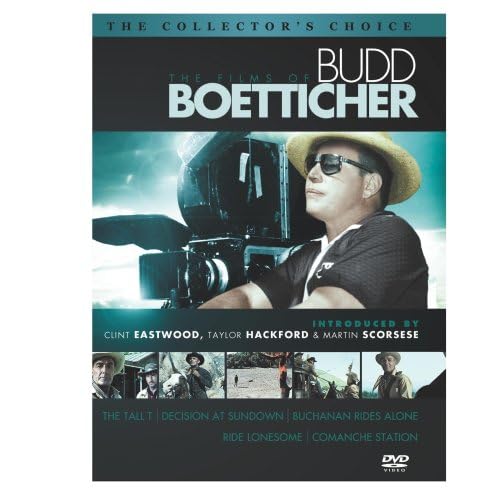 The five-disc set The Films of Budd Boetticher from Sony Pictures Home Video more than doubles the number of Boetticher films on DVD (before the release of this box set, only four of his 35 features were available, and only a few more on VHS and laserdisc), but more importantly, it finally gives this American director his due with beautiful editions of his essential films, especially his definitive The Tall T (mastered to fit the 16×9 frame) and his widescreen classics Ride Lonesome and Comanche Station, all tightly scripted by Kennedy with a lyrical approach of dialogue, all set in an increasingly abstract nowhereland of the desert. The offbeat black comedy Buchanan Rides Alone and the grim Decision at Sundown are minor companion pieces with a few major pleasures (among them a beautiful turn by a young L.Q. Jones as an amiable young cowpoke in Buchanan). In all of them, Boetticher took the “limitations” of his stiff, craggy star and turned them into essential elements of his characters: a hard, inexpressive man at home on a horse and in the wilderness, a survivor with few words and no wasted actions. The same can be said for Boetticher’s direction: every shot of his best films is austere and pared to the essentials, yet directed with an ease that made them live and breath. Martin Scorsese provides a marvelous video introduction to The Tall T (and, by extension, the entire series) and Ride Lonesome with a mixture of historical perspective and cinephile love of the films and Clint Eastwood introduces Comanche Station, but an even greater contribution is the documentary Budd Boetticher: A Man Can Do That, a feature-length portrait of the director and his life and career produced by Eastwood and directed by Bruce Ricker.


