Posted in: Documentary

Grizzly Man: The Overwhelming Indifference Of Nature

It’s easy to see why Werner Herzog was so fascinated by Timothy Treadwell, the former beach bum turned self-made wildlife activist and grizzly bear guardian who spent thirteen summers living amidst the grizzly bears of the Katmai National Park and Preserve in Alaska until he, along with his girlfriend and traveling partner, Amie Huguenard, was mauled, killed, and devoured by his beloved cause.

Timothy Treadwell: Grizzly Adams as new age surfer dude

As his documentary Grizzly Man suggests, Treadwell saw himself as a new-age Grizzly Adams with a video camera and a quest to save the habitat from humanity. He could be a real life folk version of the dreamers from Herzog’s dramas, less manic and not as prone to epic gestures but no less obsessed. Treadwell relentlessly videotaped his sojourns and the magnificent footage that he left behind captures a serenity and savagery of the wilds at times reminiscent of Herzog’s best films.

But the footage also serves his self-made mythological identity—”the lone guardian of the grizzly”—by constantly and pointedly placing himself in every shot, like the host of a non-existent nature show/nature reality series. His footage is accompanied by grandiose stream-of-consciousness running commentary, a mix of naturist idealism, poetic romanticism and a kiddie-show host blissing out on the wonders of mother nature. He speaks of the isolation of his solo forays into the wilds, even though he was accompanied and assisted by female partners/girlfriends on practically every trip, and is careful to never mention their presence, let alone allow them to share credit in his adventure. Amie, the girlfriend who was killed with Treadwell, is only glimpsed only twice in the background of footage Treadwell left behind, and even there is barely present.

Read More “Grizzly Man: The Overwhelming Indifference Of Nature”

Posted in: Documentary

Losing Focus: Three Herzog Shorts – The Dark Glow of the Mountains, The Ballad of the Little Soldier, Little Dieter Needs to Fly

The Dark Glow of the Mountains (1984), suffers from limitations imposed by its subject: the effort of two daredevil climbers to scale two difficult mountains back-to-back, without a break in between. They describe this as something never done before and much more dangerous than climbing one peak. The aesthetic problem, though, is that the available footage was evidently limited to what Herzog shot in conjunction with interviews, and there is no real visual evidence of danger or drama.

Werner Herzog in the Dark Glow of the Mountains

The interviews are colorful enough, in their way. One climber boasts that, thanks to frostbite on previous climbs, he is down to four toes; his colleague, perhaps somewhat sheepishly, admits to having all ten, but does note [hopefully?] that, with the difficult project they are undertaking, that could change. Aside from the unique and unprecedented nature of the stunt, and its danger, neither climber cites any particular reason for doing it. The more seasoned of the two—the one with four toes—concedes that he climbs compulsively, and gravitates toward doing new things; unless I’m missing something, that is another way of saying he does it to keep from getting bored. This is quite a jarring contrast to the ski jumping in The Great Ecstasy of the Sculptor Steiner (1974), which Herzog transformed into a mystical pursuit of the transcendent and the poetic. It seems odd to find Herzog, a decade later, celebrating the things mountain climbers do to ward off boredom. And without climbing footage, the film is inert; even the announcement that they have successfully climbed the second mountain registers as curiously flat, almost anti-climactic.

Read More “Losing Focus: Three Herzog Shorts – The Dark Glow of the Mountains, The Ballad of the Little Soldier, Little Dieter Needs to Fly”

Posted in: Documentary, Essays, Film Reviews

Land of Silence and Darkness: What it Means to be Human

Land of Silence and Darkness(1971) was Herzog’s first feature-length documentary (his previous feature, Fata Morgana [1971] begs to be classed as a metaphysical documentary, but by Herzog’s daffy description, is sci-fi). The subject matter, the struggle for human communication, is such a natural for Herzog that in some ways the film is quintessential early Herzog. It follows Fini Straubinger, a leader of, and advocate for, the deaf and blind in Germany, through a life of constant activity, entertaining and visiting people without sight or hearing. But the narrator tells us that after she first lost her sight and hearing in a fall down stairs, she was bed-ridden for seventeen years. The tremendous drive and will that enabled her, finally, to rise from her bed is now channeled into the almost obsessive drive to communicate that is the implicit subject of the film, or at least its central mystery and driving force.

Land of Silence and Darkness

Herzog seems determined to share her point of view: the film’s opening shot, a distorted black and white image of clouds above a road anticipates her later account of a dream describing her memories from when she could see and hear. But the film’s ability to share her point of view is limited by a perverse tension inherent in trying to use film—a medium that communicates solely through the senses of sound and sight—to examine people who can neither see nor hear.

Lacking words, Fini communicates with others and perceives the external world through touch. The film describes a touch alphabet, in which different types of touches express verbal symbols. But the most telling communication in the film comes from touches that create a sensory sharing more immediate and less ordered than language.

Read More “Land of Silence and Darkness: What it Means to be Human”

Posted in: Documentary, Film Reviews

Signs of Life: Longing for a Rational, Ordered World

Although Signs of life (1967) was Herzog’s first feature film, it has few of the self-conscious, look-at-me-making-a-movie film school tricks that often characterize first efforts. Compared to the director’s later work, it seems muted, but it contains many of its director’s signature motifs and devices: strikingly bizarre, expressive images; off-beat, occasionally off-the-wall humor rooted in behavioral eccentricities; a sense of the limitations of verbal communication; visual and verbal references to moving in circles; and an obsessive concern with how characters confront a natural order that is often indifferent, if not actively hostile, to human aspirations.

Signs of Life
Signs of Life

As a strictly fictional film, Signs is closer to Stroszek (1977)—the central character in each is named Stroszek—than to much of Herzog’s intervening work. Signs even employs a narrator whose comments apparently impose order on the action by explaining and describing it. Certainly, compared to later films like the wildly anarchic Even Dwarfs Started Small (1970), Signs seems almost conventional.

Stroszek’s situation in Signs of Life is typically ironic and perverse. A paratrooper we never see leave the ground, he was wounded in occupied territory, during a lull in the fighting, circumstances that, perversely, offered the illusion of safety. He is introduced in extreme long-shot as a helpless, wounded figure; we are told he is a passenger in a truck crossing a desolately beautiful landscape, and we first see him as a motionless figure on a stretcher being carried into a hospital. Through the balance of the film, his world remains out of kilter, and eventually he goes mad and assaults the world, setting off fireworks to prevent the sun from rising.

Read More “Signs of Life: Longing for a Rational, Ordered World”

Posted in: by Sean Axmaker, Documentary, Film Reviews

Not Quite Hollywood – Disreputable and Delirious Downunder Movies

Mark Hartley’s unabashedly affectionate Not Quite Hollywood: The Wild, Untold Story Of Ozploitation!, his tribute to Australian genre cinema, is one of the rarities that justifies my passion for documentaries about films and film history: a smartly made look at an otherwise neglected aspect of film history and culture, packed with colorful stories, witty observations, punky attitude and real history, and delivered with unrestrained passion and excitement for the subject. This is Hartley’s feature debut, but his resume includes scores of featurettes on Australian movies—from the official classics to the cult items, the high and low of cinema culture—for DVD supplements. In addition to the first person history this has given him, it’s also been an entrée to the directors, actors and other filmmaking folks of the era, and he is able to bring a wealth of voices to his film: witnesses to the thriving domestic Australian cinema that gets overlooked in the rush to praise the more respectable and dignified offerings.

As Hartley reminds us, there was no Australian film industry to speak of—and certainly no celebrated Australian New Wave, with its gentile historical subjects and tasteful filmmaking—when producers like John D. Lamond and Anthony I. Ginnane and directors like Tim Burstall cashed in on the newly-minted ratings code of 1971. They turned out raucous R-rated sex romps and boorish comedies to critical disdain and popular success, not just domestically but internationally as well. When the nerds-and-boobs (and more!) formula wore thin at the box office, horror films (Patrick, 1978, Razorback, 1984), action movies (The Man From Hong Kong, 1975) and car culture outlaw thrillers (Stone, 1974, Mad Max, 1979) became the coin of the grindhouse and drive-in realms, many of them quite profitable, most of them exportable, virtually all of them deplored by the Antipodeon arbiters of taste and culture.

The history of these films and the filmmaking culture behind it is entertaining enough, but behind the great tales of Dennis Hopper on an alcohol and drug-fueled tear during Mad Dog Morgan (1976)and Barry Humphries proclaiming the projectile vomit gags of the early seventies Barry McKenzie films as “one of the great moments of Australian cinema” is a portrait of filmmaking on the professional frontier. These filmmaker didn’t just push the envelope of censorship, they created their own genre industry, which resulted in an anything goes attitude when it came to creating thrills.

Read More “Not Quite Hollywood – Disreputable and Delirious Downunder Movies”
Posted in: Documentary, DVD

Of Time and the City and Alexander Korda – DVDs for the week

Of Time and the City (Strand)

timeandthecityIf Liverpool did not exist, it would have to be invented. And in some ways, that’s what Terence Davies does in his cinematic essay, a personal remembrance of a city that he recalls from his ambivalent perspective of troubled affection and critical commentary. Freely mixing history and remembrance, documentary and commentary, Davies offers up a very personal look at his hometown of Liverpool and the age in which he grew up in England. Though only brief moments of the film are actually shot by Davies himself (the rest is a mix archival newsreel clips, documentary footage, TV news clips and home movies), this is as personal as filmmaking gets and he personally narrates with a witty collection of literary quotes, song lyrics, movie titles and snatches of poetry delivered with a twist of his own sardonic humor. The port city and industrial center on the northwest coast of Britain is best known in America as the birthplace of the Beatles. They have little place in Davies’ remembrance. Though his commentary is backed by a collection of popular songs and snatches of classical music, it’s not the music of the culture so much as of Davies’ life, and by the sixties he had tuned out with the coming of The Beatles and the Mersey Beat and turned to classical music. That was also the time he discovered that he was gay and the culture that he thought was his turned out to be quite hostile to him.

It’s chronological, both temporally and personally, from the post-war years to the present, and he takes us from B&W to color in a particularly delightful transition involving the crowds taking the ferry to Brighton. “They got on in black and white, but they got off in color,” he deadpans, and from that moment the film remains in color. It’s the modern world and nostalgia is gone as Davies recalls his coming of age in every way. His view of the church shifts to one of suspicion and distrust and a class consciousness seeps in as he observes the royal family (“another fossil monarchy”) and its lavish pageants of marriage and coronation while millions lived in poverty, destitute in slums all over Liverpool. He reserves his most caustic commentary for royalty and the national obsession with the royal family.

Read More “Of Time and the City and Alexander Korda – DVDs for the week”

Posted in: Documentary, DVD, Film Reviews

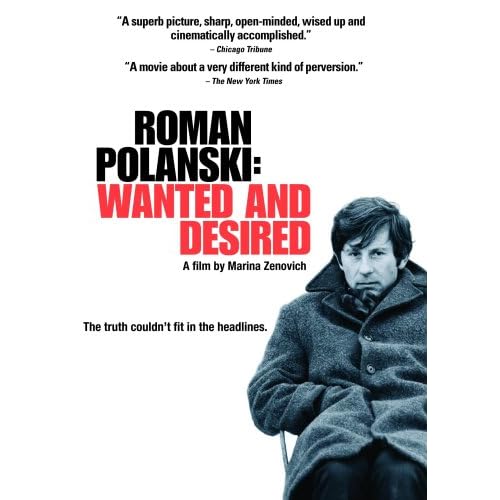
“Roman Polanski: Wanted and Desired” – DVD for the Week 1/27/09

Is Marina Zenovich’s documentary Roman Polanski: Wanted and Desired in fact the “DVD of the Week” this week? I mean, is it the standout film this week, or an overlooked masterpiece, or a superior use of the DVD medium? Or am I just reaching to fill the slot of a weekly feature?

Some of the latter, possibly. Woody Allen’s Vicki Cristina Barcelona debuts on DVD and Blu-ray this week and it is probably the best new film of the week, while Martin Ritt’s Edge of the City and John Schlesinger’s Far From the Madding Crowd make their respective DVD debuts as well. All of them in simple movie-only editions (as if the Woodman would ever offer a commentary track). And my favorite release of the week is Shout! Factory’s three-disc set of The Secret Policeman’s Balls, which collects the performance films of five Amnesty International Benefit shows, from Pleasure at Her Majesty’s in 1976 (featuring members of Monty Python’s Flying Circus, Beyond the Fringe and The Goodies) to The Secret Policeman’s Biggest Ball in 1989, featuring a rare reunion of Peter Cook and Dudley Moore among the comedy treats. The art is all onstage, however, as the films are basically no more than straight record of an event.

But Roman Polanski: Wanted and Desired is a fascinating film and a terrific DVD. The film delves into the story of Roman Polanski’s notorious statutory rape of a 13-year-old girl, his indictment on six felony charges and his subsequent flight from the U.S. in 1977. Polanski’s story reaches much farther back, of course, and is framed by his history: he survived the Holocaust that killed most of his family and endured the murder of his pregnant wife Sharon Tate and the insatiable, irresponsible media circus that hounded Polanski and recklessly smeared his reputation before the investigation discovered and arrested Charles Manson and his followers (giving the press an even more sensationalistic story). That might screw up anyone, but it hardly explains or justifies Polanski’s “relationship” (his word) with 13-year-old Samantha Gailey, plying her with drugs and alcohol before having sex with her. The film doesn’t flinch from Polanski abhorrent crimes (to which he confessed and plead guilty) and the excerpts of police interview transcripts with Polanski and Gailey are discomforting and disturbing.

Read More ““Roman Polanski: Wanted and Desired” – DVD for the Week 1/27/09″