One underappreciated aspect of criticism is how it can sometimes spin gold from flax. Case in point, a silly little vidcast dialogue (it never raises to the level of an argument) between A. O. Scott and David Carr on the nature of film critics is eminently skippable; but, in submitting it to one of the epic Fiskings of all time, Jim Emerson carves out one hell of a mission statement for his profession.
“But if you had kept on, if you’d loved it enough to keep on fighting and struggling, why that fight would show in your face today—in your eyes, in your whole being.” David Bordwell’s anatomy of film acting reaches the putative windows to the soul, and proves it’s not the eyes themselves that communicate, but the lids and brows. Which very, very few have wielded so expressively at Bette Davis.
“Where there’s revolution there’s confusion and when there’s confusion a man who knows what he wants stands a good chance of getting it.” Introducing a Film Forum retrospective, J. Hoberman offers a political reading of the Spaghetti Western, a genre inspired by Fanon and Gramsci as much as Ford, and traces its left-leaning sentiments to some key Hollywood westerns of the previous decade. (A brief note in the comments from Dave Kehr intriguingly suggests the lineage stretches back even further, to ’30s Bs.)
At Artforum, photographer Taryn Simon and Brian De Palma talk about their all-consuming passion: the perfect image, the focus necessary to achieve it, and the efforts of governments to censor it once it’s made. Yes, the pair met collaborating on Redacted; but don’t hold that against them, it’s a rather interesting discussion.
“In a zombie apocalypse (Night of the Living Dead) or a secret alien takeover (Invasion of the Body Snatchers), you fall asleep one evening and when you wake up in the morning the world has changed. Your relatives and your friends, your neighbors and the friendly folks who run the dry cleaners reveal themselves as the monsters they’ve always been, beneath the lie of civilization, of affection. They look the same, but now they want to destroy you, to consume you. And you have to keep running.” Colson Whitehead sums up the lessons learned—some silly, some transcendent—from an adolescence steeped in horror and sci-fi flicks.
Erich Von Stroheim and friends in 'The Wedding March' (1928)
“The newspaper mogul and moral crusader Martin Quigley called Greed ‘the filthiest, vilest, most putrid picture in the history of motion pictures.’ Stroheim retorted, ‘You Americans are living on baby-food.'” Prompted by a Film Forum retrospective, Imogen Smith assesses what one can of the mangled filmography of Erich von Stroheim, finding a moral absolutist who knew how to please a crowd, a hyper-realist less interested in realism than in truth, and an actor forced into a series of self-parodying roles who kept finding the dignity buried therein.
Among other fine links, Girish Shambu notes Here & Now, an intriguing new blog project from Michael Koresky. Picking a year, then three representative films, Koresky is attempting to parse out his own understanding of a given era by skidding backwards and forwards in time with the movies. (1948, for instance, offers the “marvelous images of Manhattan” from Portrait of Jennie, the “fixed and inescapable” frozen time of Rope, and the “desperate moment” captured in Germany Year Zero.) A nifty idea for cinema-as-time-machine, and one so far worth riding along with.
As recounted by Ben Slater, there was more interesting drama behind the cameras than made it onscreen for the first American production shot in Singapore, 1969’s Wit’s End, aka Dragon Lady (“packs the punch of the Orient!”), aka The GI Executioner. With a separate collection of screenshots reminding you even the most indifferently made film invaluably documents cities now lost or never seen. Link via David Hudson.
David Cairns uses two 1948 mermaid movies—the British Miranda and America’s Mr. Peabody and the Mermaid—to point out some differences between the two nations. Though it’s hardly fair to praise England for a healthier, more forthright eroticism when their nymph was played by Glynis Johns.
“A black friend of mine, after seeing Henry Fonda in The Grapes of Wrath, swore that Fonda had colored blood. You could tell, he said, by the way Fonda walked down the road at the end of the film: white men don’t walk like that! and he imitated Fonda’s stubborn, patient, wide-legged hike away from the camera.” At Kino Slang, Andy Rector posts James Baldwin’s excellent, provocative reading of Lang’s You Only Live Once, from The Devil Finds Work.
Say this if you’re looking for a silver lining: Who ever thought Kathryn Bigelow would be mainstream enough that one of her films would be helped along by classified leaks from the White House? Yet that’s exactly what happened during the preproduction of Zero Dark Thirty. Here’s your links, helpfully sorted in order of outrage. If this strikes you as, ok, odd, but honestly no big deal, The Playlist has you covered. If you’re somewhat troubled by the implications, try The Guardian. Sputtering indignantly at the confluence of statist arrogance and Hollywood propaganda? Glenn Greenwald’s your man. And if you’re barely even upset because really, what did you expect after we placed a socialist traitor in the Oval Office, join the conversation at Judicial Watch, the organization which (admirably, in all sincerity) obtained the government records and has posted them online to sort through yourself.
“Creating something beautiful and becoming beautiful oneself are indistinguishable.” John Bailey recalls one of the highlights of filming Mishima: working with the incomparable Eiko Ishioka.
Whatever the financial tally when all’s said and done, the contributors to this year’s For the Love of Film blogathon have simply provided too many riches on too many topics to offer any meaningful list of highlights; any such won’t so much scratch the surface as gently buff it. So head over to the event’s three hosts—The Self-Styled Siren, Ferdy on Film, and This Island Rod—and sample the offerings for yourself.
“I would rather make the gravest of mistakes than surrender my own judgment.” A recent screening of The Last of the Mohicans was followed by a Michael Mann Q&A with Geoff Boucher. Kristopher Tapley has the highlights, but even he admits these outtakes can’t do justice to the wide-ranging, highly detailed thoughts you’d expect from Mann, so he’s fortunately appended the audio from the evening.
“That Epstein’s films are uneven is part of their essential nature; he was genuinely experimenting, aiming not for a consistent level of craft or a seamless vehicle for narrative, but for moments that would kindle, images that would pierce.” The Chiseler’s Imogen Smith discusses, in prose nearly as vivid and transfixing as their imagery, three films by Jean Epstein.
In a similar vein, Ed Howard surveys the six “fascinating, poetic documentaries” that Maurice Pialat shot in Turkey in 1964, with topics ranging from studies of harbor life to the region’s religious history to the spectacle of a three-day wrestling match.
“He said, ‘We’re going up to Big Sur, we’re going to shoot up there.’ And we went up there. That’s where I met what’s-his-name, who makes the wine. Coppola.” The great Dick Miller (his recollections charmingly buttressed by his wife Lainie), interviewed for the A.V. Club by Caelum Vatnsdal, looks back at the barest fraction of the films he’s made. Which still makes for a wealth of anecdotes.
“Do you know what time it is?” “A watch doesn’t really go with this outfit, daddy.” Josie Sampson revisits Clueless, and praises the deliberately tacky, “tasteless attempts at sophistication” of its costume design, a vibrant marker of childish things to be put away.
Federico Fellini, Jean Cocteau, Giulietta Masina at Cannes 1953
The Movie Morlocks’s morlockjeff’s two-part runthrough of the lesser-known, offbeat, and sometimes outright embarrassing byways of Mickey Rooney’s career becomes, when you remember that unique sprite’s indefatigable energy, a litany of perseverance both pathetic and oddly heroic, Rooney pressing on full bore whether aiding a talking duck, forcing a captive to play out Cyrano de Bergerac, or crawling about in a diaper and breast-feeding from Marianne Sagebrecht.
Also at the Morlocks, Kimberly Lindbergs offers some of her favorite photographs chronicling the Cannes festival, from Louis Lumière meeting in a train station with the town’s mayor to a lovely 1959 image of Cary Grant and Kim Novak lost in one another’s eyes. Another post, covering the ’60s, is to follow.
Even before seeing the colorfully desolate images, hanging midway between cinematic studies and tourist snapshots, of Wim Wenders’s latest photo exhibit, the title ‘Places, strange and quiet’ would probably give you a hint as to their maker. The Deichtor Hallen Hamburg offers a slideshow (click “Dia Show” at bottom right on the banner); a few more are viewable at Wenders’s own website. Spotted by Criterion.
The weekly links page is compiled and curated by Bruce Reid in collaboration with the editor of and contributors to Parallax View.
A few months ago you couldn’t throw a rock without beaning a think-piece on silent cinema prompted by The Artist and Hugo. Geoffrey O’Brien in the New York Review of Books caps the mini-genre with a winner, a lovely hymn to silent movies as “a perpetual learning how to see, and a way of coming to the truth of one of Emerson’s observations: ‘The eye is final.'”
Regrettable as it is that such a well-regarded figure in the New German Cinema as the late Werner Schroeter still requires an introduction before his first North American retrospective, Brooklyn Rail’s Mónica Savirón is ably up to the task.
“Let Britain brag her motley rag/We’ll lift the green more proud and airy/Be mine the lot to bear that flag/And head the men of Tipperary!” Apologies that my forgetfulness let slip the new issue of Screening the Past last week. The silent film journal devotes its entire issue to the 1918 Irish classic Knocknagow, placing the movie at the center of fascinating histories of Irish cinema, popular song, and even sport–with national pride coloring them all. Spotted, among others, by Film Studies for Free.
“Right now, I’m revolting against the conventions of movies. Who says a film has to cost a million dollars and be safe and innocuous enough to satisfy every 12-year-old in America?” Fifty years after her debut feature screened, fifteen years—sadly—after her death, Shirley Clarke and The Connection are making headlines again, courtesy of a restoration and return to theaters. Manohla Dargis offers a career retrospective, shot through with disbelief that such a game-changer remains a marginal figure in the histories. At Indiewire, Ann Hornaday and David Sterritt discuss how forward-thinking, and mischievous, the director truly was. Glenn Kenny takes exception to the glibness of that latter description in a fine appreciation. Milestone Films, for whom this is merely the first step in restoring many of Clarke’s films, also deserve a nod for their informative press kit, source of the opening quote and well worth a read. [this last link is a .pdf]
That last link above was spotted by David Hudson, as all of them are eventually. Hudson’s film roundups, which render efforts by others (yes, even Your Humble Aggregator) superfluous, have a new home at Fandor, which partnership is kicked off with a marvelous find: Trevor Stark’s history, from October Magazine, of Chris Marker and the SLON film cooperative’s partnership with workers from the Rhodiaceta textile factory in France. A revolutionary effort—admirable in its intentions, stymied by fractionalism and mistrust—that Marker, inevitably, viewed through the lens of the cinematic past, in this case Medvedkin’s ciné-trains. [.pdf]
“She knows the score…She’s someone who was abused. I could identify with her. I never could identify with any other white movie star. They were always white people doing white things.” Jacqueline Rose, in a beautifully written article that sniffs out more connections than most books on the subject, finds Marilyn Monroe the perfect embodiment of mid-century America—not the one we dreamt on movie screens, but the sometime cruel, confused one most pretended wasn’t happening.
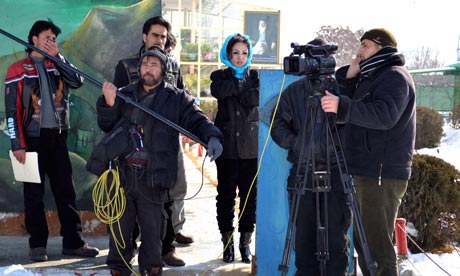
Director Saba Sahar and crew
Onscreen, Saba Sahar is “a kind of superhero, doing kung fu high-kicks in traditional dress, carrying victims to safety over her shoulder or riding a motorbike with no hands while firing a gun.” Behind the scenes, Afghanistan’s first woman director is far more impressive, as Jenny Kleeman’s profile attests.
“I always presume every movie I make is my last. My career is very smoothly in decline, each movie making half as much as the prior one.” Todd Solondz, interviewed at the Sarasota Film Festival by David Carr, on the business end of things, working with actors, and how he stole a key scene in Welcome to the Dollhouse from North by Northwest. Link via Movie City News.
Who created that greatest of silent icons, The Tramp? Surviving recollections from Chaplin and Sennett mostly stake their claim each against the other, but John Boorstin points out it’s no stretch at all to infer considerable credit should go Mabel Normand’s way.
From the oeuvre of "the elder, least pretentious, and most consistently amusing Anderson of the current director trifecta"
Time Out didn’t fool around compiling their list of the 100 best horror films, polling a murderer’s row of 126 experts (the Cs alone offer up Roger Corman, Antonio Campos, Alice Cooper and Coffin Joe) and writing up the results with good observations and considerable brio. Which allows for some admirably off kilter selections, though lest you think this lineup differs radically from other such, the accompanying interview is still with William Friedkin. Noted by David Hudson.
The New York Film Academy may be a barely credible institution, but they know an opportunity when they see it. Thus their series of classes in the blossoming film community of Nigeria. Become the Dream, as the bodyguards’ t-shirts urge.
Revisiting The Devil, Probably, Dennis Lim assigns the same uncompromising nihilism that ensured the film’s relative obscurity to the draw it has on its partisans. Link, one of several of interest, via Girish Shambu.
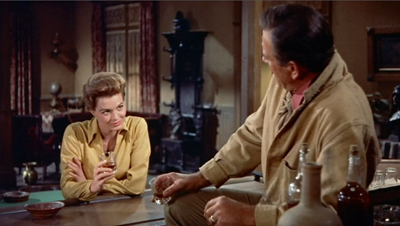
She Who Is Called Feather Meets He Who Is Called Chance
“She Who Is Called Feathers manifests the most dazzling changes in raiment.” David Bordwell and Kristin Thompson’s mock exegesis on Rio Bravo isn’t just a delightfully sustained gag, but a vessel for several profound interpretations of the film, including a deconstruction of some song lyrics that is, keeping with their conceit, revelatory.
A father’s haunting anecdote about the moral confusions of living in a nation under occupation kicks off what is shaping up to be a lovely project from Vermillion and One Night’s Murderous Ink: a survey of Japanese films from 1949 that the writer digs his way into by scratching at items ostensibly in the margins. Thoughts on the superstitions around Crepe Myrtle and the rareness of tomatoes expand a grief-ridden scene from Kurosawa’sStray Dog; and Ozu’s Late Spring and Tadashi Imai’s Green Mountains become two more stops in Japan’s ongoing anxieties over women riding bicycles.
Your latest round-up on the hazards and economic hardships of switching to digital projection comes via the L.A. Weekly.
The article above opens with a discussion of Christopher Nolan’s recent screening for fellow filmmakers of a sequence from The Dark Knight Rises, in an attempt to proselytize for the benefits of 35mm over video. Nolan discusses the subject, as well as his directing style (which, surprise, is highly pragmatic and orderly) with the DGA’s Jeffrey Ressner. Link via Movie City News.
“A few years ago, I thought I might open a chain of eulogy stores where you could go in off the street and, for twenty bucks, they’ll tell you all the nice things they’re going to say about you after you croak. But I don’t want people to say wonderful things about me when I can’t hear them. Tell me now, while I’m still here.” The multilingual journal La Furia Umana takes Jerry Lewis at his word, making him the subject of their latest issue. Plenty of good stuff here even for those of you currently rolling your eyes, from Sadarshan Ramani’s tracing Lewis (and Tahslin) as inspiration for King of Comedy‘s Rupert Pupkin; Steven Shaviro’s closely observed defense of Smorgasbord‘s (aka Cracking Up) “therapeutically purging” humor; and if you missed it the first time around (2003, in The Believer), B. Kite’s magisterial The Jerriad: A Clown Painting, one of the finest bits of writing ever done on Lewis, not least for its succinct delineation of an essential opposition: “Buster makes extraordinary feats look incredibly easy. Jerry makes mundane activities seem extremely difficult.”
The timing for such celebration, of course, is that The Kid just celebrated his 86th Birthday. Publicly, in fact, with Richard Belzer as MC and an audience Q&A that went pretty much the way you think it did. J. Hoberman fills in the details.
Contains information related to marketing campaigns of the user. These are shared with Google AdWords / Google Ads when the Google Ads and Google Analytics accounts are linked together.
90 days
__utma
ID used to identify users and sessions
2 years after last activity
__utmt
Used to monitor number of Google Analytics server requests
10 minutes
__utmb
Used to distinguish new sessions and visits. This cookie is set when the GA.js javascript library is loaded and there is no existing __utmb cookie. The cookie is updated every time data is sent to the Google Analytics server.
30 minutes after last activity
__utmc
Used only with old Urchin versions of Google Analytics and not with GA.js. Was used to distinguish between new sessions and visits at the end of a session.
End of session (browser)
__utmz
Contains information about the traffic source or campaign that directed user to the website. The cookie is set when the GA.js javascript is loaded and updated when data is sent to the Google Anaytics server
6 months after last activity
__utmv
Contains custom information set by the web developer via the _setCustomVar method in Google Analytics. This cookie is updated every time new data is sent to the Google Analytics server.
2 years after last activity
__utmx
Used to determine whether a user is included in an A / B or Multivariate test.
18 months
_ga
ID used to identify users
2 years
_gali
Used by Google Analytics to determine which links on a page are being clicked
30 seconds
_ga_
ID used to identify users
2 years
_gid
ID used to identify users for 24 hours after last activity
24 hours
_gat
Used to monitor number of Google Analytics server requests when using Google Tag Manager
1 minute
Marketing cookies are used to follow visitors to websites. The intention is to show ads that are relevant and engaging to the individual user.
A video-sharing platform for users to upload, view, and share videos across various genres and topics.
Registers a unique ID on mobile devices to enable tracking based on geographical GPS location.
1 day
VISITOR_INFO1_LIVE
Tries to estimate the users' bandwidth on pages with integrated YouTube videos. Also used for marketing
179 days
PREF
This cookie stores your preferences and other information, in particular preferred language, how many search results you wish to be shown on your page, and whether or not you wish to have Google’s SafeSearch filter turned on.
10 years from set/ update
YSC
Registers a unique ID to keep statistics of what videos from YouTube the user has seen.
Session
DEVICE_INFO
Used to detect if the visitor has accepted the marketing category in the cookie banner. This cookie is necessary for GDPR-compliance of the website.
179 days
LOGIN_INFO
This cookie is used to play YouTube videos embedded on the website.


 One underappreciated aspect of criticism is how it can sometimes spin gold from flax. Case in point, a silly little vidcast dialogue (it never raises to the level of an argument) between A. O. Scott and David Carr on the nature of film critics is eminently skippable; but, in submitting it to one of the epic Fiskings of all time, Jim Emerson carves out one hell of a mission statement for his profession.