


Bobby Roth appeared on the film scene in the mid/late Seventies with a handful of insightful and clearly personal indie movies, a decade or so before “American independent cinema” became an official designation. The Boss’ Son and Circle of Power in particular impressed us, though they hardly prepared us for this writer-director’s breakout moment, the 1984 Heartbreakers — a sharply observed account of some trendy L.A. lives in crisis, featuring Peter Coyote in an Oscarworthy performance and commanding Ten Best acknowledgment (though, of course, no Oscar nominations). From then on, a Bobby Roth credit has been an earnest of quality and commitment above and beyond, whether on made-for-cable features — Baja Oklahoma, Dead Solid Perfect, Rainbow Drive — or episodes of smart shows such as Miami Vice, Crime Story, or (an especially memorable hour) the late, lamented Boomtown. Over the years, he’s continued to work in commercial television but squirreling away financing for his own, too-infrequent personal films: Jack the Dog, Manhood, and now Pearl — streaming August 11 on Amazon, Vudu, FandangoNow, iTunes, Comcast, et al. —Richard T. Jameson
Pearl tenderly unravels the ties that break and bind a colorfully flawed family—beautiful wild-child mom (Sarah Carter); suicidal father (Anthony LaPaglia), orphaned Beverly Hills princess-turned-pauper and her wonderfully boozy grandma (Barbara Williams). At the heart of Bobby Roth’s wise and redemptive film is Pearl, a 15-year-old who struggles out of horrific tragedy to stumble toward hard-earned maturity. (Larsen Thompson, the striking young actress who plays Pearl, presents her expressive face to the camera like a beautiful and precious gift.) Pearl quietly celebrates purpose regained for a lost father and daughter. It will ring true for any soul who has learned that life, blighted by terrible loss, may still flow on, seeking green pastures. —Kathleen Murphy

 “…What Ford had been evolving all through his career was a style flexible enough to establish priorities of expression. He could dispose of a plot quickly and efficiently when he had to, but he could always spare a shot or two for a mood that belonged to him and not to the plot.” —Andrew Sarris, The American Cinema


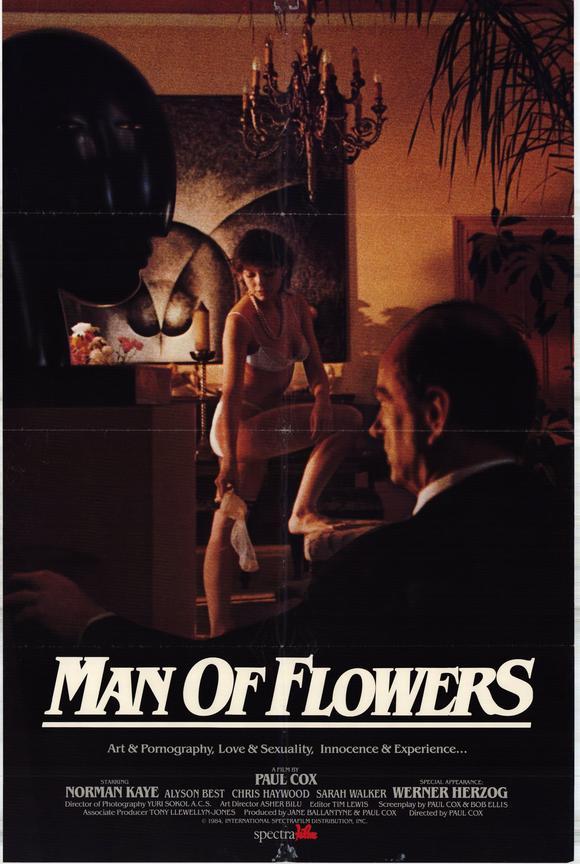 Paul Cox’s Man of Flowers begins with a painting and a striptease. In the case of the former (which appears behind the opening credits), the camera eye is at first focused in tight, on the refined profile of a Renaissance nobleman and, to his left, a pale forest of organ pipes. An actual forest is visible in the distance—to be precise, part of a meticulously landscaped park of which the gentleman seems to be taking survey from a balcony. Still inventorying the details of the painting—patterns of shrubs and trees, the statue of a satyr—the camera drifts rightward and then starts to withdraw slowly, so that we begin to perceive the composition entire. The last element we become aware of is a naked woman, alabaster and robust, a curving landscape unto herself and the real focus of the man’s transfixed (we now recognize) gaze.


